
The Metropolitan Police have seized more than 2,500 illegal e-bikes and e-scooters in London so far in 2026, per a BBC report published around July 25, 2026 by Amy Walker for PA Media. That already passes the 2,241 seized across all of 2025, with five months still to run.
The method matters more than the total. Officers are checking machines against an assistance speed limit at the roadside, and a bike that looks entirely normal can fail that check.
What the Met Actually Reported
Per the BBC, the campaign is framed around road safety and crimes committed using powered two-wheelers, phone theft in particular. On Friday, officers seized 29 e-bikes and 7 e-scooters near Tottenham Court Road Station, the seventh such operation in London in 2026, with five more scheduled through the summer.
Commander Neerav Patel, quoted in the report, drew a line worth keeping: legitimate riders are not the target, and the focus is illegal and antisocial use, phone snatches included.
Electrek’s July 26 write-up restates the same PA-sourced facts, so treat the two as a single source of record rather than independent confirmations.
E-Bikes and E-Scooters Are Two Different Problems
The seizure total lumps together two categories that sit in very different places under UK rules.
Per the BBC, privately owned e-scooters are illegal on UK public roads. That is a status question, not a speed question: the machine does not have to be fast, modified, or ridden badly to be unlawful there. The wording points at private ownership specifically, so confirm rental scheme rules separately.
E-bikes are the opposite case. They are lawful when they meet the legal requirements, so the enforcement question is whether a particular bike still does. That is what the roadside testing is for.
How the Roadside Dyno Check Works
The Met and Nottinghamshire Police are using portable roadside dyno kits, also called rolling roads. The driven wheel sits on rollers so the bike runs under power while stationary, and the equipment reads the speed the motor keeps assisting to.
The reference point is 15.5 mph (25 km/h). Some seized machines recorded speeds above 27 mph (43 km/h), which is light motorcycle territory rather than bicycle territory.
Reported inspection signals and their limits
data| Signal | What the reporting says | What it does not settle |
|---|---|---|
| Assisted speed on the rollers | Dyno kits check whether the motor assists past 15.5 mph (25 km/h). | No published protocol, tolerances, or handling of borderline readings. |
| Throttle that moves the bike without pedaling | Listed among the things officers look at. | No description of how throttle types or assist-start systems are assessed. |
| Large battery | Noted as something inspectors observe. | Capacity alone is never called an offense. |
| Privately owned e-scooter on a public road | The BBC states these are illegal on UK public roads. | About e-scooters, not e-bikes. Confirm rental rules separately. |
The Crime Statistics Need a Caveat
The Met also reported neighborhood offenses down 14% over the 12 months to June, theft from person down 23%, and personal robbery down 11%.
These are police-reported figures presented alongside the campaign, and the pairing invites an obvious conclusion. Resist it. Nothing here establishes that the seizures caused the declines. Crime trends move for many reasons over periods far longer than a set of enforcement days, and no analysis separating this operation’s effect from everything else has been published. That is correlation, presented by the force running the campaign.
A Practical Checklist Before You Buy or Modify
This matters most in the used market, where a bike’s history is exactly what you cannot see. Ordinary buyer diligence, not a legal opinion:
- Save the manufacturer specification for the exact model and model year. A spec sheet naming the stated assisted speed and motor output beats a listing that can be edited later.
- Establish where motor assistance actually stops. Ask in writing, then compare the answer against the manufacturer’s published figure.
- Clarify how the throttle behaves. Whether the machine moves under power without pedaling is a specific question. Vague answers are the answer.
- Ask whether the controller, display, or firmware has been changed. Speed unlocks usually live in a swapped controller or a reflashed display, invisible from outside. Ask what was replaced, when, and by whom.
- Check battery provenance. Ask whether the pack is original, who built any replacement, and what documentation exists. That is a fire-safety question first; our battery replacement and recall checklist covers what to record.
- Verify the rules where you actually ride, before money changes hands. A seller’s confidence is not a legal position.
US Readers: Do Not Import the 15.5 mph Number
None of this determines what is legal in the United States. The 15.5 mph (25 km/h) figure is the limit these UK operations check against, and it does not apply to US riders.
US e-bike legality generally runs through the three-class system plus state and local rules that vary on throttle use, path access, and rider age. A machine that would be seized in London may be lawful in your state, and one lawful in your state may be banned on the trail two towns over. Our e-bike laws by state guide and e-bike classes explainer are starting points, not substitutes for your state statute and municipal rules.
The transferable lesson is not the threshold. It is that enforcement increasingly turns on what a machine can actually do rather than the label on it, and US agencies have been moving the same way, as our coverage of enforcement in Folsom, California shows. If that question feels uncomfortable for a bike you are shopping, start with why an e-moto may not be an e-bike.
FAQ
FAQ
+Does a large battery make an e-bike illegal in the UK?
+Are e-scooters treated the same way as e-bikes?
+Did the seizures cause the drop in London crime figures?
+Do UK rules affect what I can legally ride in the United States?
Sources
- Record 2,500 illegal e-bikes and e-scooters seized by Met Police (BBC News, around July 25, 2026, by Amy Walker / PA Media): primary source for the seizure totals, operation details, inspection methods, speed figures, crime statistics, and quoted police position.
- Met Police break their own record for seizing illegal e-bikes (Electrek, July 26, 2026, by Micah Toll): secondary coverage restating the same PA-sourced facts.
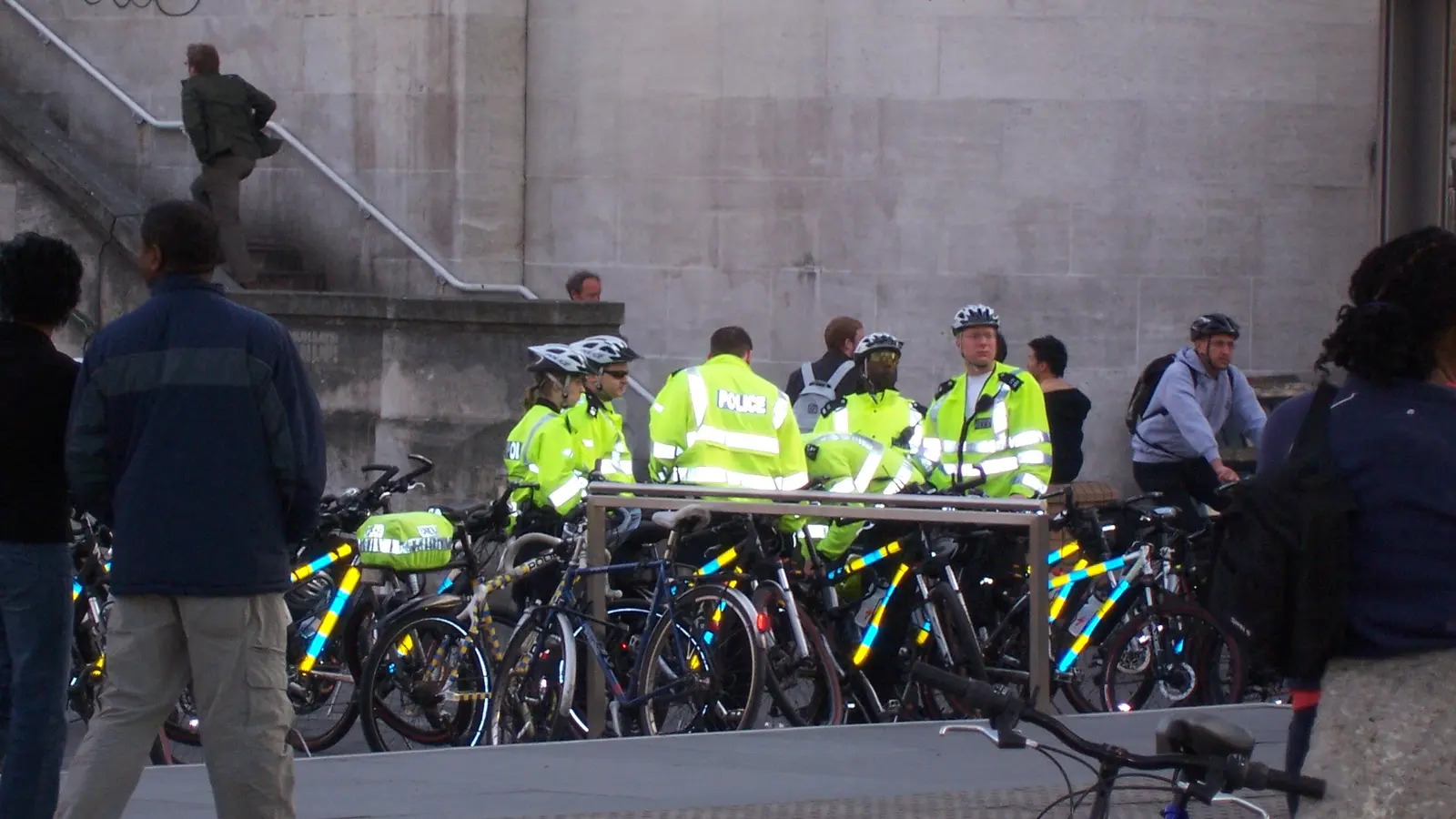
- Metropolitan Police officers at Critical Mass London, April 2006 (Wikimedia Commons, by Neilius, CC BY-SA 2.5): the hero image, an archival photo used illustratively. It does not show the 2026 operations.
