
Momentum, the city-bike brand backed by Giant Group, has pulled the cover off a new commuter called the Vida E+ EX, and on paper it hits the marks a lot of daily riders actually shop for: a mid-tier price, a removable battery big enough for a real commute, and a comfort-first build. Electrek reports the bike at $1,985 with a 500 W hub motor, Cruise Mode, and an optional dealer-installed throttle. That is a tidy package for the money.
There is one detail that is not tidy, and it is the detail that decides where you can legally ride this bike. Electrek describes the Vida E+ EX as a Class 3 e-bike with pedal assist up to 28 mph. Momentum’s own current US specification table labels the bike ASTM/EN Class 1, and its marketing copy says Cruise Mode holds a set speed up to 20 mph. Those two descriptions point at different bikes for legal purposes, and until the exact US configuration is nailed down, that gap is the first thing a buyer should resolve.
What Momentum Actually Announced
The Vida E+ EX is built around Momentum’s SyncDrive Move S rear hub motor. Both Electrek and Momentum’s official spec sheet list it at 500 W and 60 Nm of torque, running on a 48 V system with torque, cadence, and speed sensors. That sensor mix matters more than the wattage headline, because a torque sensor is what makes assist feel like it is responding to your legs rather than switching on and off.
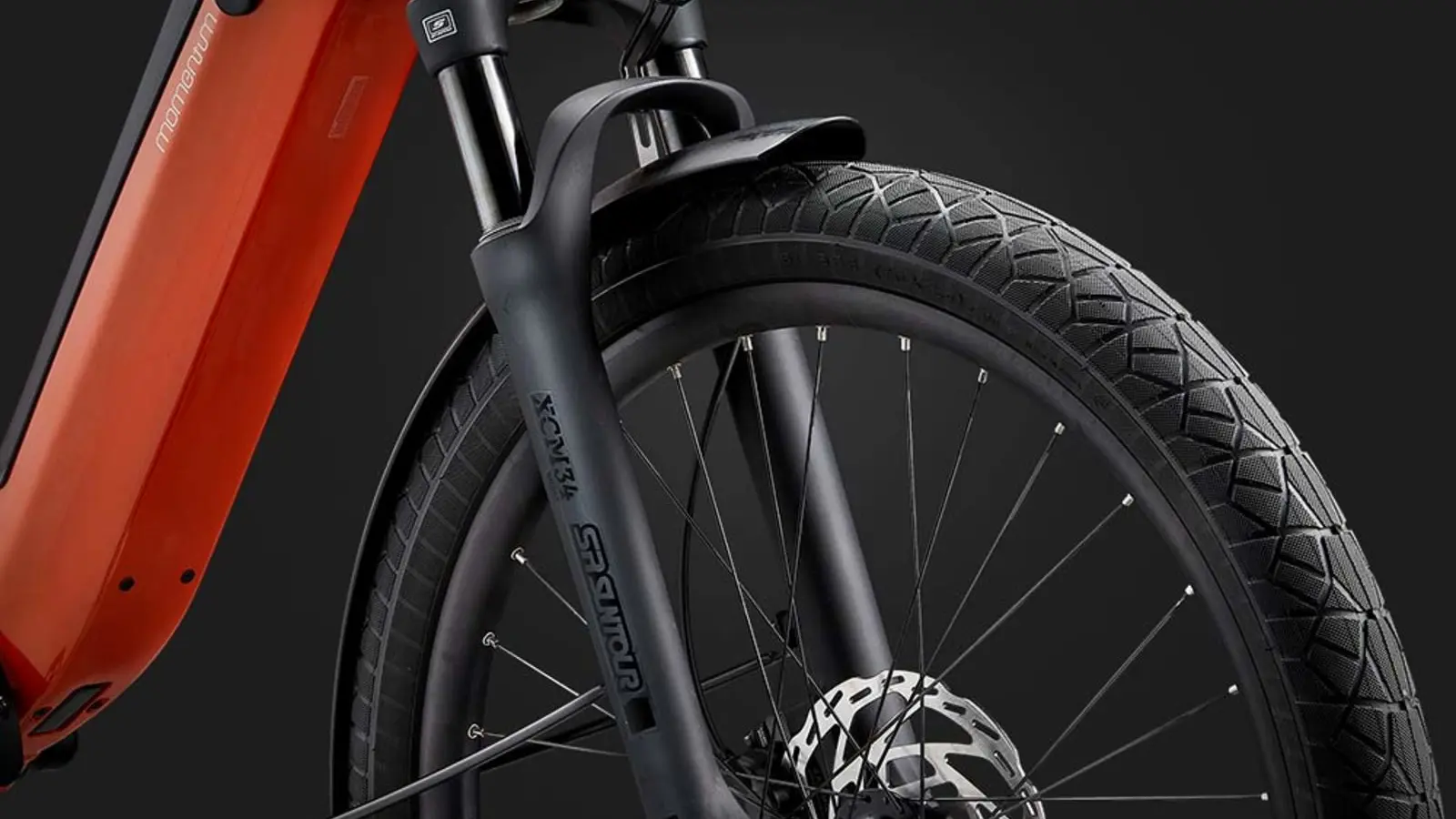
The rest of the build reads like a purpose-made commuter. Electrek reports a low-step aluminum frame, an 80 mm suspension fork, 26 by 2.4 inch tires, an adjustable dropper seatpost, integrated fenders and lights, integrated brake lights, hydraulic disc brakes, and a MIK-compatible rear rack. Momentum lists UL 2849 system certification, its RideControl app, and a digital E-Lock. The removable battery is listed by Electrek at 700 Wh (Momentum calls it the Energy 700), which is the part that makes charging indoors and leaving the bike in the garage a realistic routine.
Momentum Vida E+ EX: what the sources report
data| Spec | What the sources report | Source |
|---|---|---|
| Motor | SyncDrive Move S rear hub, 500 W, 60 Nm, 48 V | Electrek and Momentum |
| Sensors | Torque, cadence, and speed sensors | Momentum |
| Battery | Removable 700 Wh (Momentum Energy 700) | Electrek and Momentum |
| Class rating | Class 3, pedal assist up to 28 mph (Electrek) vs. ASTM/EN Class 1 with Cruise Mode up to 20 mph (Momentum) | Conflicting |
| Throttle | Ships without a throttle; optional dealer-installed 0-start throttle for $65 | Electrek |
| Range estimate | 40 to 55 miles on pedal assist, 31 to 43 miles with heavier throttle use | Electrek |
| Charging | 80 percent in 4 hours 40 minutes, full in a little over 6 hours with the 3A charger | Electrek |
| Load capacity | 300 lb combined rider and cargo; 33 lb front rack; rear rack 55 lb (Electrek) / 59.5 lb (Momentum) | Electrek and Momentum |
| Price | $1,985 US, plus $65 for the optional throttle; excludes tax, shipping, and fees | Electrek and Momentum |
The Class Rating You Have to Settle Before You Buy
Here is the discrepancy in plain terms, because it is the single most important thing on this page. Electrek reports the Vida E+ EX as a Class 3 bike with pedal assist up to 28 mph. Momentum’s current official US specification table labels the classification ASTM/EN Class 1, and the brand’s own marketing copy describes Cruise Mode as maintaining a set speed up to 20 mph. Those are not the same bike in the eyes of a bike-path sign or a state law.
RoostMode is not going to guess which one is correct, and neither should you. It is possible this reflects different market configurations, a spec sheet that has not caught up to the launch, or a difference between the pedal-assist ceiling and what Cruise Mode does. We do not know, so we are not going to invent an answer. What we can tell you is exactly what to do about it: before you order, confirm the specific US configuration, the top assist speed, whether Cruise Mode changes that speed, the exact class label on the bike you would receive, and whether that class is legal where you actually ride.
The reason this matters is that Class 1 and Class 3 are treated very differently. A Class 1 bike, capped at 20 mph pedal assist with no throttle, is the most widely permitted class on bike paths and multi-use trails. A Class 3 bike, with assist up to 28 mph, is faster but is restricted from some paths and often carries extra rules on helmets and minimum age. If that distinction is fuzzy, our guide to e-bike classes 1, 2, and 3 lays out what each one means in practice.
Cruise Mode and the Optional Throttle
Two features drove the announcement. The first is Cruise Mode, which Electrek reports is meant to hold a set speed on longer stretches, the way cruise control works in a car. Momentum’s marketing copy ties that mode to a 20 mph ceiling. For a rider covering flat, uninterrupted miles on a commute or a rail trail, a set-speed function can take some strain out of holding a steady pace, though how useful it feels in stop-and-go city traffic is a separate question that only a ride can answer.
The second is the throttle, and Momentum handled it in a way worth noting. Electrek reports the Vida E+ EX ships without a throttle, and a 0-start throttle is offered as a dealer-installed option for $65. A 0-start throttle can move the bike from a standstill without pedaling, which changes both how the bike feels and, in many places, how it is classified and where it can go. If you want the throttle, ask the dealer how adding it affects the bike’s class and your local legality, since that answer can differ from the throttle-free version.
Range and Charging, Read the Numbers Carefully
Electrek reports an estimated 40 to 55 miles on pedal assist and 31 to 43 miles with heavier throttle use. Treat those as estimates, not a promise. Manufacturer and first-look range figures are measured under favorable conditions, and real numbers drop with rider weight, hills, cold weather, tire pressure, and how much assist you lean on. The 700 Wh battery is a genuinely useful size for the price, but plan your commute around the low end of the estimate, not the high end.
Charging is a practical bright spot. Electrek reports the included 3A charger reaches 80 percent in 4 hours 40 minutes and a full charge in a little over 6 hours. That is slow enough that you will want to charge overnight rather than topping up between errands, which is another reason the removable battery is a real convenience. Pull the pack, carry it inside, and leave the bike wherever it lives.
Who Should Care, and Who Should Wait
The Vida E+ EX is aimed squarely at the practical commuter who wants a comfort-oriented city bike from a brand with a dealer network behind it, rather than a spec-chasing bargain from an online-only seller. The low-step frame, dropper post, fenders, lights, and rack are the features that make a bike get ridden on a wet Tuesday instead of sitting in the garage. UL 2849 system certification is a reassuring line item on the safety front, since battery certification is one of the things worth insisting on.
The buyer who should slow down is anyone whose riding depends on a specific class. If you need a Class 1 bike to use a particular trail, or you want the 28 mph ceiling of a true Class 3 for a longer road commute, the current spec discrepancy means you cannot yet be sure which bike you are getting. That is not a reason to rule it out. It is a reason to get the configuration confirmed before money changes hands.
What to Confirm Before You Order
Treat this launch the way you would treat any new e-bike, and get the following in writing before you buy:
- Class and local legality. Confirm the exact class label, the top assist speed, and whether that class is legal on the paths, trails, and roads you ride. The Electrek versus Momentum discrepancy makes this non-negotiable here.
- Throttle setup. Decide whether you want the $65 dealer-installed 0-start throttle, and ask how adding it changes the bike’s class and your local legality.
- Range for your riding. The 40 to 55 mile estimate is a best case. Ask about range at higher assist and with your weight and terrain, and plan around the low end.
- Out-the-door price. The $1,985 MSRP excludes tax, shipping, fees, and dealer-installed options, and Momentum notes dealer prices and fees can vary. Get the real total.
- Service and support. Ask the dealer what warranty and repair look like, since a bike you can get serviced locally is worth more than a slightly cheaper one you cannot. Our dealer directory is a place to find a shop near you and compare against the wider market.
Momentum bringing a Giant-backed commuter in at this price is good news for shoppers, and the equipment list is the kind that gets a bike used rather than parked. Just make the class question the first thing you settle, not the last.
FAQ
FAQ
+Is the Momentum Vida E+ EX a Class 1 or Class 3 e-bike?
+How much does the Vida E+ EX cost?
+Does the Vida E+ EX come with a throttle?
+What is the range and how long does it take to charge?
+What motor and battery does it use?
+Should I buy it now or wait?
Sources
- Electrek: Momentum’s new Vida E+ EX commuter e-bike adds cruise control, throttle, and more (Micah Toll, July 14, 2026)
- Momentum: Vida E+ EX official product page (US)