North Carolina is getting a statewide definition for e-bikes, and it is arriving because local governments could not agree on one. Island Free Press reports that Gov. Josh Stein signed House Bill 1094, a wide-ranging transportation bill that includes new e-bike provisions, and the changes take effect Dec. 1, 2026.
Until now, individual towns and counties across the state have been writing their own e-bike rules from scratch, with no shared statewide definition of what an e-bike even is. That patchwork is most visible on the Outer Banks, where six Dare County towns currently handle e-bikes six different ways. The new law does not erase those local rules. It gives them a common statewide foundation to sit on top of.
What the Law Actually Does
According to Island Free Press, House Bill 1094 defines three types of electric-assisted bicycles statewide, allows them on roads, bike lanes, and multiuse paths unless a local government says otherwise, and gives cities and counties explicit authority to regulate e-bikes on sidewalks and multiuse paths. The provisions take effect Dec. 1, 2026.
That combination matters. The state is setting one set of definitions everyone has to use, while explicitly leaving the sidewalk-and-path decisions to local government. It is a floor, not a ceiling.
The reporting also notes that the law directs the North Carolina Department of Transportation to develop educational materials on e-bike use and safety, though no timeline or content for those materials was detailed.
The Three Classes, As Defined in the Law
Per Island Free Press’s reporting, the law defines the classes this way:
- Class 1: provides assistance only when the rider is pedaling, and stops assisting at 20 mph.
- Class 2: can propel the bicycle without pedaling, and also stops assisting at 20 mph.
- Class 3: provides assistance only when the rider is pedaling, and stops assisting at 28 mph.
If those definitions sound familiar, it is because they mirror the three-class framework already used in many other states. Our guide to e-bike classes 1, 2, and 3 breaks down how that system works in more general terms.
The Helmet Rule for Riders Under 18
The reporting is specific on one safety requirement: riders younger than 18 must wear helmets while operating or riding as passengers on Class 3 e-bikes. Class 3 is the fastest of the three categories, with assistance running up to 28 mph, so the higher speed ceiling comes with a mandatory helmet requirement for minors.
Cities also may require helmets for riders younger than 18 on Class 1 and Class 2 e-bikes, according to the reporting. That is optional local authority, not a statewide mandate. Whether a Class 1 or Class 2 rider under 18 needs a helmet will depend on where they are riding, not just what the state law says.
Local Governments Keep Authority Over Sidewalks and Paths
The part of the law most likely to affect day-to-day riding is what it leaves to local control. Island Free Press’s reporting says cities may regulate e-bikes on sidewalks and multiuse paths, including restricting one or more classes of e-bikes or setting speed limits. Counties have similar authority. State parks and historic sites may continue to be regulated separately by the Department of Natural and Cultural Resources.
The Outer Banks shows how differently that authority can be used even within one region. Per the reporting:
- Duck allows legal e-bikes on the Duck Multiuse Trail but bars e-bikes and conventional bicycles from concrete sidewalks in the Village Commercial District between the Aqua Restaurant crosswalk and the Sunset Grille and Raw Bar crosswalk, and prohibits reckless operation.
- Nags Head prohibits electric-assist vehicles on the multiuse pedestrian path along South Virginia Dare Trail and South Old Oregon Inlet Road, but allows them on the Croatan Highway multiuse path. It also bars motorized or electric-assist vehicles on sidewalks narrower than 8 feet and prohibits reckless operation.
- Manteo prohibits non-pedestrian use, including e-bikes, on town-managed boardwalks, docks, and piers.
- Kill Devil Hills has not adopted a townwide e-bike path ban in its codified ordinances. Its code requires bicyclists on sidewalks, multi-purpose trails, or walkways to use due caution, avoid endangering others, and yield to pedestrians. The town has also launched an e-bike safety information page and says electric motorcycles and mopeds were not legal e-bikes under earlier state law.
- Southern Shores considered a 2022 ordinance that would have barred e-bikes from town sidewalks and multiuse paths except at crosswalks or intersections, but the Town Council took no action and sought more public input instead.
- Kitty Hawk has discussed e-bike concerns on its multiuse paths in public meetings, including in 2025 council materials, but the reporting found no codified townwide e-bike ban in available town records.
Dare County itself has also acted separately from its towns. The reporting notes the Dare County Sheriff’s Office issued a public safety reminder after receiving numerous e-bike complaints, and Dare County Parks and Recreation banned e-bikes at all county parks this spring, citing daily problems with children speeding through parking lots, sidewalks, playground areas, and athletic fields. Under that park policy, e-bikes must be walked through county parks, and continued violations can lead to suspension from park property. Dare County Schools has also adopted a policy, beginning in the 2026-27 school year, that prohibits students from operating, riding, or otherwise using e-bikes on school grounds, sidewalks, parking lots, walkways, inside buildings, at school-related activities, or while under staff supervision. Students may still bring e-bikes to school if they walk them and store them in designated areas.
None of these local rules come from the new state law. They are separate local and county actions the reporting describes as part of the backdrop the state law is arriving into.
What Buyers and Riders Should Take From This
If you ride or plan to buy an e-bike in North Carolina, a few things follow directly from the reporting.
- Know your class before Dec. 1. Check the manufacturer’s stated class and top assisted speed against the state’s three definitions. A Class 3 bike carries the under-18 helmet requirement; Class 1 and Class 2 may or may not, depending on the city.
- Check local rules separately from state rules. The state law does not standardize sidewalk and multiuse path access. Confirm the rules for the specific town or county where you plan to ride, since Island Free Press’s own reporting shows those rules vary widely even within a single region. Our state-by-state e-bike law guide is a starting point for the broader picture.
- Do not assume an electric motorcycle or moped counts as an e-bike. Kill Devil Hills’ safety messaging, cited in the reporting, specifically warns that these vehicles were not legal e-bikes under earlier state law. Nothing in this reporting says that has changed.
- Talk to a local shop if you are unsure. A dealer familiar with North Carolina’s classification system can help you avoid a bike that does not match what you actually need. Our dealer directory can help you find one.
Island Free Press frames the law as a tool that could make enforcement more consistent by giving towns uniform definitions to work from, while still leaving them the authority to tailor rules to specific sidewalks, boardwalks, parks, and paths. For the Outer Banks specifically, the reporting is clear that the underlying debate over crowded, shared paths is not going away on Dec. 1. The new law changes the definitions everyone is arguing from, not the argument itself.
FAQ
FAQ
+When does North Carolina's new e-bike law take effect?
+What are the three e-bike classes under the new law?
+Do riders under 18 need a helmet?
+Does the state law override local sidewalk and path rules?
+Are electric motorcycles or mopeds covered by this e-bike law?
We will keep an eye on how individual towns adjust their local ordinances once the state definitions take effect Dec. 1.
Sources
- New state law clarifies e-bike rules as Outer Banks communities wrestle with safety, local restrictions (Island Free Press)
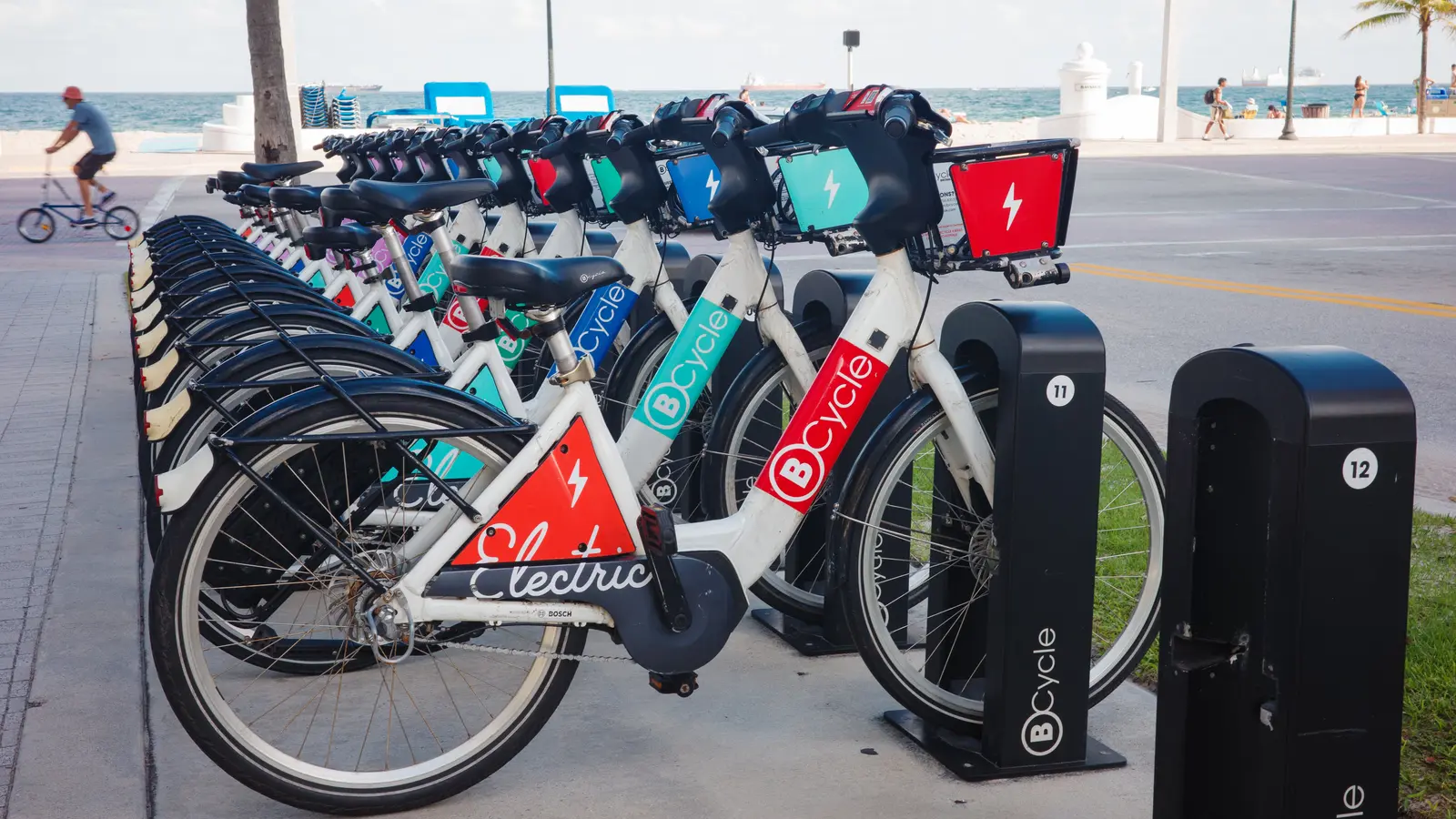
- Hero image provenance: Electric Wheels in Fort Lauderdale, Florida, CC BY 2.0 (Wikimedia Commons)
