
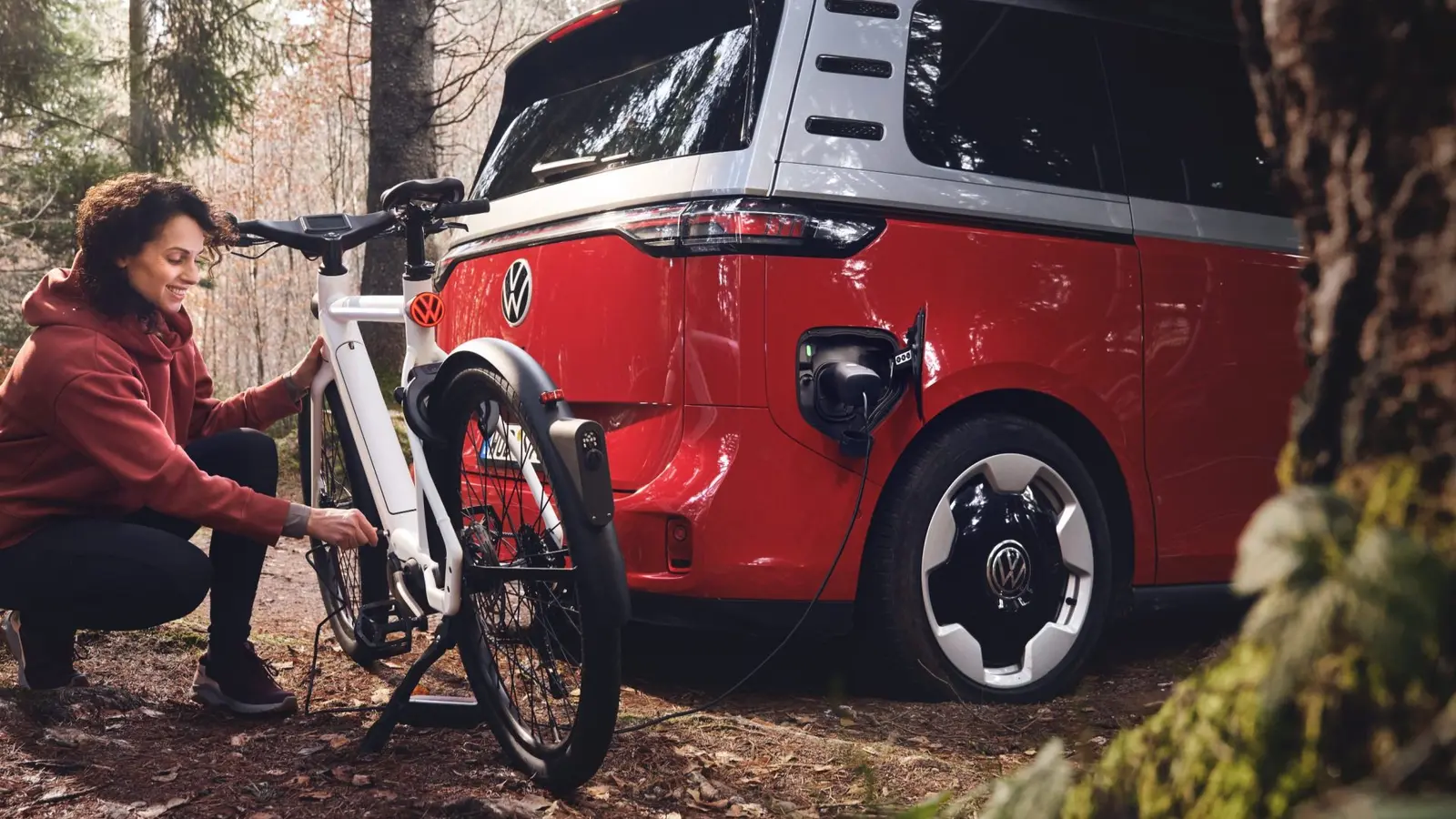
The most car-like e-bikes announced this year do not come from a car company’s factory. Zag Daily reports that n+, the e-bike maker known for its brand-licensed bikes, has unveiled a Volkswagen-licensed range with a handlebar-mounted rear-view camera, radar-activated blind-spot alerts, and a top-tube LED strip that glows red under braking and amber for turns. There is even an optional smart helmet and a pair of smart glasses that put ride information in your field of vision.
Get one thing straight before the badge does its work on you: Volkswagen is not building these bicycles. n+ designs and makes them under a Volkswagen license. That is not a knock, but it changes whose engineering, whose support network, and whose track record you are actually buying. Electrek’s Micah Toll raised the same question in the July 21 report, wondering how much of this is actually Volkswagen and how much is n+ lending its e-bikes, as it did with its Mercedes-branded models.
The two named individual-rider models are the Volkswagen Sports eBike and the Volkswagen Crossover eBike, per Zag Daily, and the sensor package is the genuinely interesting part of this launch. Renewable Energy Magazine reports the system is called Smart View; Electrek describes it more narrowly, as the radar-assisted rear-view camera system built into the handlebars. Every technical claim below still traces back to n+ and Volkswagen rather than to independent testing, but three published reports make the picture for buyers meaningfully more complete than it was at launch. Here is what has been reported, and the questions that still need answers before anyone should reach for a wallet.
What n+ Announced
Zag Daily reports two named models for individual riders: the Volkswagen Sports eBike and the Volkswagen Crossover eBike. The names suggest a road-leaning model and a do-more-things model, but no report details how the two differ in geometry, components, or intent. Electrek does not name individual models at all, referring only to a lineup, so the model names rest on Zag Daily’s reporting.
The shared story is the sensor suite. A handlebar-mounted rear-view camera gives the rider a live view of what is behind them, and radar-activated blind-spot alerts signal when a vehicle approaches. Electrek frames the Smart View package as a substitute for mirrors and shoulder checks: live rear video and blind-spot warnings on the rider’s display, keeping eyes on the road ahead.
The lighting has a name of its own: Smart Lights, a full-length LED strip embedded in the top tube that works as a daytime running light and changes color to indicate braking and turn signals, matching the red-for-braking, amber-for-turns behavior in the launch coverage. Electrek also relays an important caveat straight from n+: some of these lighting functions are not currently street legal in every market. No report lists which markets or which functions are affected, so ask n+ directly before you count on the turn signals or brake lighting where you ride.
On the drivetrain, the sources agree and extend each other. Zag Daily reported a 250W motor rating and assisted speed up to 25 km/h; Electrek adds the supplier, 250W Yamaha mid-drive motors, and describes the 25 km/h top assisted speed as EU legal. The claimed range of up to 162 km with the fitted downtube battery appears only in Zag Daily’s report. Those numbers place the bikes squarely in the standard European pedal-assist category, which matters for buyers outside Europe, and we will come back to that.
Then there are the wearables. An optional Volkswagen-licensed Smart Helmet syncs with the bike over Bluetooth and mirrors the braking and turn lighting, so the signals ride at driver eye level instead of down on the frame. The reports describe its crash detection slightly differently: Renewable Energy Magazine says an accelerometer detects a crash and sends a text to loved ones, while Electrek says the helmet can automatically notify emergency contacts. Compatible descriptions, but neither has been demonstrated to reviewers. Smart Glasses put navigation prompts, blind-spot alerts, and ride information in the rider’s field of vision, toggled, per Renewable Energy Magazine, by an intentional eye movement toward the top right. Electrek adds a colorful provenance claim from n+: the HUD technology comes from engineers who previously developed helmet displays for fighter pilots. That is a marketing pedigree, not a performance spec.
And now there is a starting price: $3,999, per Electrek. No report breaks out pricing by model, states whether the Smart Helmet and Smart Glasses cost extra, or confirms which markets that figure applies to.
n+ Volkswagen-licensed e-bikes: what the reports say
data| Item | What is reported | Source |
|---|---|---|
| Maker | n+, building the bikes under a Volkswagen license | Zag Daily / Electrek |
| Named models | Volkswagen Sports eBike and Volkswagen Crossover eBike, both for individual riders; Electrek does not name models | Zag Daily |
| Starting price | $3,999; no model-by-model pricing, and no statement of which markets the figure covers | Electrek |
| Motor and speed | 250W Yamaha mid-drive, assisted speed up to 25 km/h (EU legal limit) | Zag Daily / Electrek |
| Camera and radar system | Smart View: handlebar-integrated rear-view camera with live video plus radar blind-spot alerts when vehicles approach | Zag Daily / REM / Electrek |
| Lighting system | Smart Lights: full-length top-tube LED strip, daytime running light, red under braking, amber for turns; n+ notes some functions are not currently street legal in every market | Zag Daily / REM / Electrek |
| Claimed range | Up to 162 km with the fitted downtube battery, manufacturer claim; not mentioned by Electrek, battery capacity unstated everywhere | Zag Daily |
| Smart Helmet | Optional, Bluetooth sync, mirrors brake and turn lighting; crash detection described as texting loved ones (REM) or automatically notifying emergency contacts (Electrek) | Zag Daily / REM / Electrek |
| Smart Glasses | HUD with navigation prompts, blind-spot alerts, and ride info; toggled by an eye movement toward the top right per REM; n+ says the HUD tech comes from former fighter-pilot helmet display engineers, per Electrek | REM / Electrek |
| Status | Reported as in production; delivery slated for Q4 2026, depending on certification under applicable EU regulations; Electrek does not give a timeline | Zag Daily |
Car Tech on a Bicycle Is the Actual Story
Rear-view cameras, radar blind-spot monitoring, and brake lights that respond to what the vehicle is doing are standard equipment on modern cars. Peter Jost of Volkswagen Accessories, Lifestyle and Licensing made exactly that point in Zag Daily’s report, saying these technologies are most commonly known from automotive applications and that their arrival on e-bikes shows how technology can be adapted.
For riders, the appeal is easy to see. The most stressful part of road riding is what you cannot see: the car closing from behind, the driver drifting into your line as you signal a turn. A live rear view plus a radar nudge when something enters your blind spot addresses that fear directly, and brake-responsive lighting gives drivers behind you the same cue they get from every car on the road. Electrek notes that rear-facing radar itself is not new, pointing to Garmin’s add-on units and radar-equipped e-bikes already on the market; integrating camera vision alongside the radar on the bike’s own display is the less common part.
The honest counterpoint is that none of this has been independently evaluated on these bikes. A rear-view camera is only as good as its screen visibility in sunlight, its latency, and whether glancing at it is actually safer than a shoulder check. Radar alerts are only as good as their false-positive rate; a sensor that buzzes at every parked car trains you to ignore it. And a HUD in your glasses is a safety feature only if it informs more than it distracts, a concern Micah Toll voiced explicitly, writing that heads-up displays risk becoming another distraction if not executed carefully. These are testable questions, and nobody has published test results yet.
The Numbers: What Is Now Known, and What Still Is Not
The biggest gap from launch week has closed. Electrek reports a starting price of $3,999 and 250W Yamaha mid-drive motors, where the launch coverage had no price and no supplier. Electrek’s assessment is worth passing along: at $3,999 for 250W and 25 km/h, these bikes will not win any watts-per-dollar contest, and they are aimed at riders who value comfort, features, and everyday usability over speed.
Two caveats on that price. First, it is a starting figure with no model-by-model breakdown, and no report says whether the Smart Helmet and Smart Glasses are included or extra. Second, Electrek quotes it in US dollars while no report confirms US availability, and the launch coverage frames the rollout around EU certification. Until n+ publishes market-specific pricing, treat $3,999 as an anchor, not a checkout total.
The claimed range of up to 162 km, about 100 miles, still deserves the standard RoostMode skepticism, and it rests on Zag Daily’s report alone; Electrek does not mention range. Manufacturer range figures are almost always produced in the friendliest possible conditions: lowest assist level, flat ground, light rider, no wind. Real-world range at the assist levels people actually use is routinely a large fraction less than the brochure number.
There is an extra wrinkle: no report states the battery’s capacity in watt-hours, and a range claim without a capacity figure cannot be sanity-checked at all. Our guide to how long e-bike batteries actually last explains how to read range claims and what actually drains a pack.
Even after the Electrek report, there is still no published weight, torque figure, charge time, or battery certification. That is normal this soon after a launch, but weight and battery capacity in particular are the two numbers a $3,999 anchor price cannot be judged without.
Built for European Rules, Not Automatically for Yours
The reported 250W Yamaha motor and 25 km/h assisted speed match the standard European pedal-assist spec, and Zag Daily reports the bikes are in production with delivery slated for Q4 2026, depending on certification under applicable EU regulations. Electrek independently describes the 25 km/h limit as EU legal but gives no delivery timeline of its own, so the Q4 2026 window remains a Zag Daily claim. That framing tells you who this launch is for: European riders, on European rules, on a European timeline that itself carries a regulatory dependency.
The legality question now has a second layer, raised by the maker itself. Per Electrek, n+ notes that some Smart Lights functions are not currently street legal in every market. The reports do not say which functions are restricted where, or whether restricted functions ship disabled. If the lighting is part of why you want this bike, that is a direct question for n+ about your specific market, not something to assume.
US shoppers should resist the urge to slot these into the American class system. A 250W, 25 km/h bike is not automatically a Class 1, 2, or 3 e-bike in the US sense, and despite Electrek quoting the price in dollars, no report says anything about US availability or a US-market configuration. If the class framework is fuzzy for you, our guide to e-bike classes 1, 2, and 3 covers how the US system works, and our e-bike laws by state guide covers how it varies once you leave your driveway. Until n+ or Volkswagen says something concrete about markets beyond Europe, this is a launch for US buyers to watch, not to plan a purchase around.
The Questions That Decide Whether This Is a Good Buy
A camera and radar package on a bicycle is a legitimately interesting idea, and a reported starting price and named motor supplier give buyers something concrete to weigh. If these bikes reach your market, here is the homework, roughly in the order it will disqualify candidates:
- What $3,999 actually buys. Electrek reports the starting price, but not which model it applies to, what the step-up model costs, or whether the Smart Helmet and Smart Glasses are included. A sensor-suite bike where the sensors’ companion wearables cost extra is a different value proposition.
- Whether the lighting features work legally where you ride. n+ has acknowledged, per Electrek, that some Smart Lights functions are not currently street legal in every market. Confirm what ships enabled in your country before treating the turn signals and brake light as features you own.
- Weight. Cameras, radar, and a full-length LED strip add hardware. Nobody has published a weight. If you carry a bike up stairs or lift it onto a rack, this number matters as much as any feature.
- Battery capacity and certification. What is the pack in watt-hours, who makes the cells, and what safety certification does it carry? Our battery replacement and recall checklist covers why certification and a named cell supplier are non-negotiable.
- Service, parts, and support. The motor is a Yamaha, per Electrek, but the camera, radar, lighting, and wearables are n+’s own connected stack. Who services all of it near you, what happens to those features if the companion app is discontinued, and can a normal shop fix the non-electronic parts? Our dealer directory can help you find a local shop to compare against.
- Verified real-world range. Wait for independent testing before treating 162 km as anything but a ceiling produced under ideal conditions.
- What the wearables require. The helmet’s crash-detection alerts and the glasses HUD presumably depend on connectivity and pairing. Confirm what needs a phone, what needs a subscription if anything, and what still works when the electronics do not.
Where This Fits in the Bigger Picture
Automotive brands lending their names to e-bikes is not new, but a licensing deal that ports over actual automotive safety concepts, rather than just a logo and a paint scheme, is a more interesting version of the arrangement. Electrek’s take lands close to ours: after years of e-bike marketing centered on bigger motors and higher speeds, safety-focused innovation is a refreshing direction, provided it does not make the bikes overly complicated or prohibitively expensive. If the Smart View system works as described, it will pressure other manufacturers to answer why their bikes cannot tell you a car is in your blind spot.
That is still a real “if.” The gap between a compelling launch announcement and a bike you should buy has narrowed with a reported price and motor supplier, but it is still filled by model-level pricing, shipping, certification, the market-by-market status of the lighting, and independent reviews, none of which exist yet. The reported Q4 2026 delivery window is itself conditional on EU certification, which is worth remembering the next time a delivery estimate slips.
We will follow up when full specifications, market availability, or independent testing appears, and we will keep the line between manufacturer claims and verified results as clear then as it is now.
FAQ
FAQ
+Is Volkswagen making e-bikes now?
+What safety technology do the n+ Volkswagen e-bikes have?
+How much do the n+ Volkswagen e-bikes cost, and when can I buy one?
+What motor do the n+ Volkswagen e-bikes use?
+How far can the n+ Volkswagen e-bikes go on a charge?
+Are these bikes legal to ride everywhere?
+Is a rear-view camera on a bike actually useful?
Sources
- N+ launches Volkswagen-licensed e-bike range (Zag Daily, July 14, 2026)
- n+ releases new Volkswagen-licensed e-bike (Renewable Energy Magazine, July 14, 2026)
- Volkswagen enters the smart e-bike game with radar, cameras, HUD glasses, and more (Electrek, July 21, 2026)