
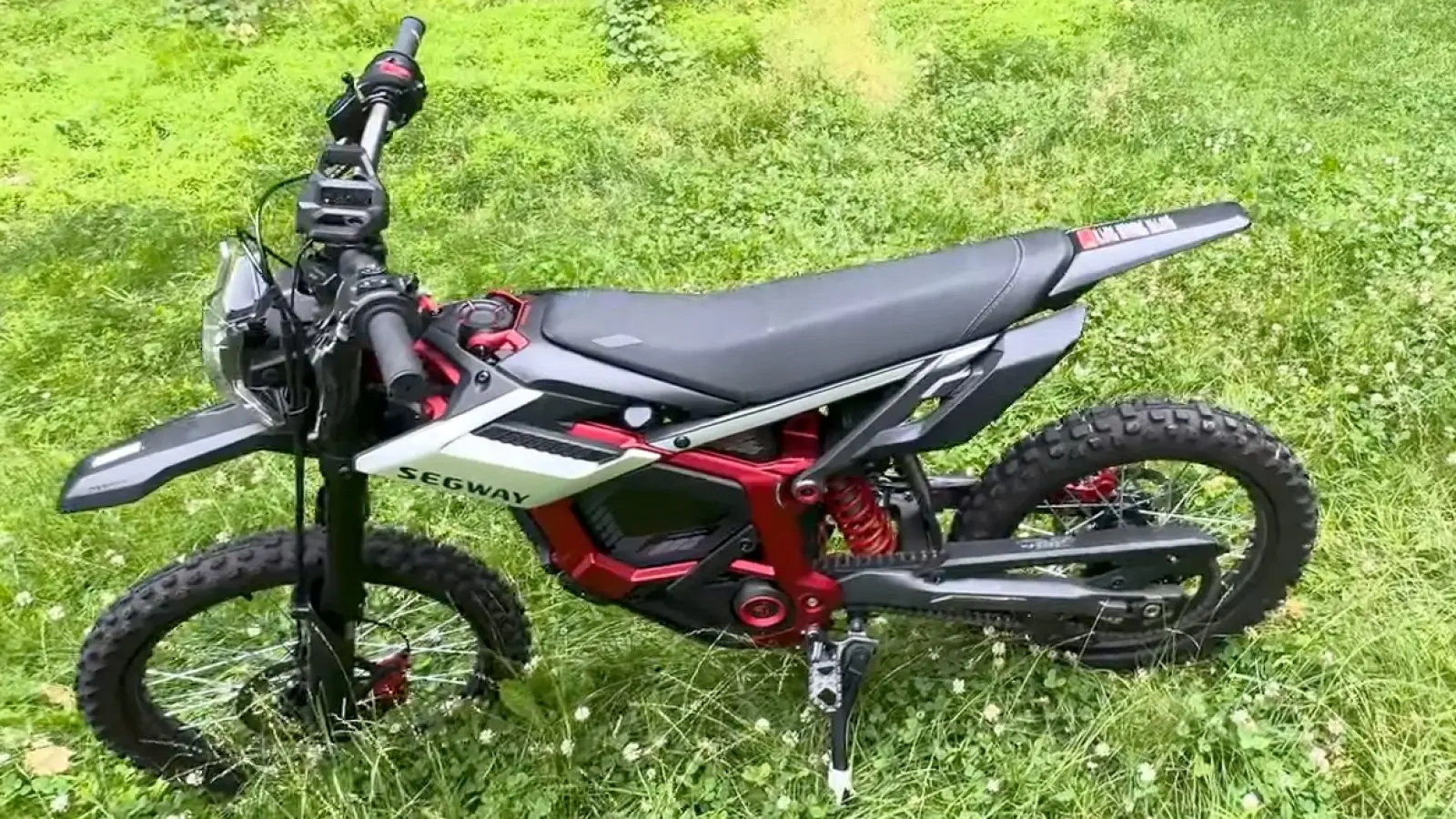
The company most people still associate with mall cops on self-balancing scooters just shipped a 187 lb off-road electric motorcycle with 21 kW of peak power, Marzocchi suspension, and a software stack that locks out full power until you have ridden 62 miles. That is the Segway Xaber 300, and Electrek’s Seth Weintraub spent the past month riding one.
His review, published July 17, 2026, lands on a big claim: the Xaber 300 at $5,299 undercuts the Sur Ron Ultra Bee’s typical pricing while bringing electronics that neither Sur Ron nor Talaria can match. Coming from a reviewer who has spent recent months on a string of budget e-motos, that verdict deserves attention. It also deserves the usual caution that applies to any first review of a first-generation machine from a brand new to this segment.
Here is what Weintraub actually observed, what comes from Segway’s own spec sheet, and what nobody can know yet.
First, Be Clear About What This Is
The Xaber 300 is not an e-bike. There are no pedals, no assist classes, and no pretense of bicycle status. It is an off-road electric motorcycle, the same category as the Sur Ron Ultra Bee and Talaria Sting, with a claimed 60 mph top speed that puts it far beyond anything the three-class e-bike system covers.
That distinction matters more in 2026 than it ever has. Cities and states are actively cracking down on e-motos ridden on streets, bike paths, and sidewalks, and our guide to why your electric dirt bike might not be an e-bike covers how riders keep getting caught out by that gap. The Xaber 300 belongs on private property, motocross tracks, and legal OHV trails, full stop.
What Electrek Actually Experienced
Weintraub’s month with the Xaber started before the riding did. Where the $1,000 to $2,000 e-bikes he usually reviews arrive in battered boxes needing an hour of assembly, the Xaber came fully assembled on a pallet. Setup was plugging in the battery and connecting the app, which he found genuinely useful rather than an afterthought. Segway also has a dealer network, with a location about 10 miles from him offering test rides before purchase.
On the trail, his impressions were consistently positive. He reports the bike is quieter and far more refined than the budget e-motos he has been riding, with motor whine replacing the chain rattle he expects from cheaper machines. On the trails behind his housing development, he says the Xaber stayed composed where a $2,000 to $3,000 Light Bee clone would bottom out.
He is equally upfront about the limits of his testing. At 50 years old, he did not push the bike through berms, jumps, or competition riding, which is the use Segway built it for. His speed observation is still telling: Segway claims a 60 mph top speed, and Weintraub reports seeing an indicated speed starting with a 7 before backing off in Beast Mode. He never measured how far past 60 it would go.
Segway Xaber 300: claims versus Electrek's observations
data| Item | What is reported | Source |
|---|---|---|
| Price | $5,299, available now through authorized dealers | Electrek |
| Peak power | 21 kW, roughly 28 hp | Segway, via Electrek |
| Top speed | 60 mph claimed; Electrek saw an indicated 70 plus before backing off | Segway claim / Electrek observation |
| Acceleration | 0 to 50 mph in 5.5 seconds | Segway claim |
| Weight | 187 lb (85 kg) | Segway figure, cited by Electrek |
| Battery | 72V, 44Ah, just over 3 kWh, Samsung 50S cells, 5C discharge rate | Segway, via Electrek |
| Range | Up to 62 miles claimed in the lowest mode; Electrek estimates 30 to 40 miles of hard riding | Segway claim / Electrek estimate |
| Suspension | Adjustable Marzocchi, 220 mm travel front and rear | Segway spec, praised by Electrek |
| Brakes | Four-piston hydraulic calipers, 220 mm rotors, front ABS | Segway spec, via Electrek |
| Power modes | 150, 200, 300, and Beast Mode; top modes locked until 62 miles ridden | Electrek, confirmed in testing |
| Software | Traction control, regen braking, virtual e-clutch, GPS, geofencing, OTA updates, 2.4 inch TFT display | Segway, via Electrek and product page |
The Software Is Where Segway Is Different
Weintraub’s core argument is that the hardware gets the Xaber into the conversation, but the electronics separate it from Sur Ron and Talaria. The bike offers four power modes named 150, 200, 300, and Beast Mode, which he describes as letting the bike impersonate different displacement classes. Mode 200, in his telling, rides like a friendly 200cc four-stroke, smooth and confidence-inspiring for newer riders.
The unusual part is the break-in lock. Segway does not let riders access the 300 mode or Beast Mode until the bike has covered 100 km, or 62 miles. Weintraub had not seen another manufacturer do this, and given how many new e-moto riders loop bikes with a fraction of this power, a forced familiarization period is a defensible safety choice rather than a gimmick.
Beyond the modes, Electrek reports traction control, regenerative braking, and a virtual electronic clutch that simulates a traditional motorcycle’s feel, which Weintraub calls a neat trick he would not use daily. Riders can also build custom modes with their own power curves and regen profiles, which is where he settled rather than living in Beast Mode. A Virtual Wheelie Coach that caps wheelie angle has been announced but was not available on his bike, so treat that feature as a promise, not a product.
Hardware: Real Motorcycle Parts at a Segway Price
The component list reads like a step up from the segment’s parts-bin norm, and this is where Segway’s scale shows. Per Electrek, the forged aluminum frame derives from Segway’s Dakar-tested prototype, suspension is adjustable Marzocchi with 220 mm of travel at both ends, and braking comes from four-piston hydraulic calipers on 220 mm rotors with anti-lock braking on the front wheel. Front ABS is genuinely rare in this class.
The battery is a 72V, 44Ah pack holding just over 3 kWh, built on Samsung 50S automotive-grade cells. Segway says the pack supports a 5C discharge rate, which is the spec behind Weintraub’s observation that power stays strong deep into the charge rather than sagging the way cheaper systems do when the throttle stays open. If cell quality and discharge ratings are new territory for you, our electric dirt bike battery guide covers why those numbers matter more than claimed range.
Small touches drew outsized praise. A full toolkit lives under the seat, with an adjustable wrench and a bit set covering every bolt on the bike. Weintraub read that as evidence riders were involved in the design, and he would like to see other makers copy it.
Range: A Claim and an Estimate, Not a Test
Nobody has published a controlled range test of the Xaber 300 yet, including Electrek. Segway claims up to 62 miles in the lowest power mode. Weintraub’s judgment is that hard riding in the higher modes will realistically cut that to around 30 to 40 miles. Both numbers are worth having, and neither is a measurement.
The honest way to plan is around the 3 kWh capacity. That is a large pack for the class, but aggressive off-road riding drains any battery fast, and a claimed maximum earned in the gentlest mode tells you little about a day of hard trail laps. If range is the deciding factor in your purchase, wait for instrumented testing before treating either figure as settled.
Against Sur Ron and Talaria, With the Caveats That Matter
Electrek’s comparison is direct: at $5,299 the Xaber 300 undercuts the Ultra Bee’s typical pricing while bringing a software suite neither Sur Ron nor Talaria offers, plus a dealer network and the manufacturing scale of a company that has moved a million units of a single scooter model. Weintraub’s headline calls it a better Sur Ron for less money, and his take is that the bike raises the bar for the segment.
RoostMode’s read is more conservative, and Weintraub himself supplies the reasons. Sur Ron and Talaria have years of proven durability, deep aftermarket support, and huge owner communities. Segway is brand new to this market, and long-term reliability, parts availability, and whether its dealers treat powersports seriously are questions no single month-long review can answer. One strong first review makes the Xaber 300 a bike to shortlist and test ride, not a settled class leader.
For the incumbents’ side of the ledger, our Sur-Ron Light Bee X versus Talaria Sting R MX4 comparison covers the bikes Segway is gunning for, and our best electric dirt bikes for adults guide puts the price bracket in context. We will update this story when independent durability data or controlled range testing appears.
FAQ
FAQ
+How fast is the Segway Xaber 300?
+Is the Segway Xaber 300 street legal?
+How much does the Segway Xaber 300 cost?
+What is the real-world range of the Xaber 300?
+Why can't you use the Xaber 300's full power right away?
+Is the Segway Xaber 300 better than a Sur Ron Ultra Bee?
Sources
- Segway Xaber review: the mall cop company just built a better Sur Ron for less money (Electrek, Seth Weintraub, July 17, 2026)
- Segway Xaber 300 official product page (Segway)