
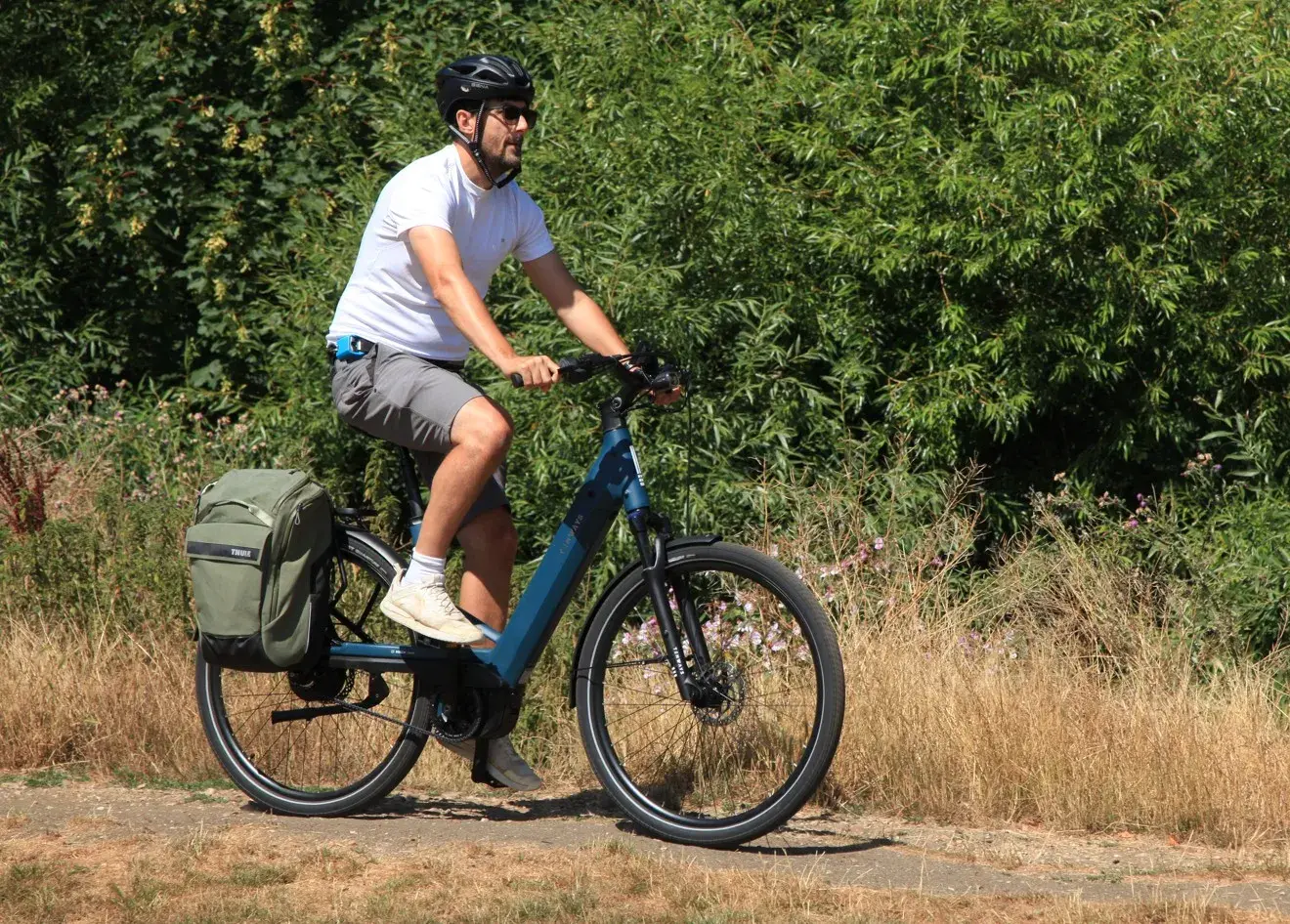
The Ago Performance is the first Tenways to use a Bosch motor ecosystem, including Bosch Smart System software, and that single change rewrites the ownership math in ways a spec sheet does not show. In the UK it buys into an established service network. It also brings a subscription question that Tenways’ own previous system did not have.
Cycling Electric’s Mark Sutton reviewed the bike and published on July 27, 2026. His read is broadly positive: good value for the parts, strong climbing, comfortable over distance, and a frame with finish and paint quality he singled out. His reservations are the kind that actually decide purchases. One frame size that may be too big for smaller riders. A stepless hub whose gear range felt weighted toward the low end. A stated 29.5 kg, which is about 65 pounds.
That review is UK coverage with UK pricing, and RoostMode has not ridden the bike. What follows separates what Sutton observed from what the manufacturer claims, then turns both into a fit, service, and verification checklist you can work through before spending anything.
What Tenways Changed, and Why It Matters More Than the Spec Sheet
The headline change is the drive system. The Ago Performance runs a Bosch Performance Line mid-drive with a Bosch 540Wh PowerTube battery, a Bosch Kiox 300 display, and Bosch Smart System software. Cycling Electric reports 75 Nm of torque and 600 W of peak support on the configuration it reviewed.
Treat those two output numbers carefully. They describe the bike Cycling Electric rode in the UK. They are not a statement about what a US-market version would produce, if one is offered, and they say nothing about how any such bike would be classified under the three-class system here. Motor output figures do not transfer across markets, and neither does legal status.
The rest of the build reads like a low-maintenance commuter brief. A Gates CDX belt instead of a chain. An Enviolo City stepless gear hub instead of a derailleur and cassette. Shimano MT200 hydraulic disc brakes, a Tenways suspension fork, CST Quantum tires, a Selle Royal Essenza saddle, an integrated 50 lux front light, an integrated rear light, a MIK HD rear rack, and a kickstand. Sutton reports the rack is rated for 27 kg, roughly 60 pounds.
Tenways Ago Performance: source specs versus Cycling Electric's ride notes
data| Item | What is reported | Source |
|---|---|---|
| Motor | Bosch Performance Line mid-drive; effective on steep paved climbs in the reviewer's riding | Source spec / Cycling Electric ride notes |
| Output | 75 Nm torque, 600 W peak support on the UK configuration reviewed | Cycling Electric |
| Battery | Bosch 540Wh PowerTube | Source spec via Cycling Electric |
| Claimed range | Up to 120 km (about 75 miles); no measured run-down test reported, and none by RoostMode | Manufacturer claim via Cycling Electric |
| Drivetrain | Gates CDX belt with Enviolo City stepless hub; range felt weighted toward lower gearing | Source spec / Cycling Electric ride notes |
| Brakes | Shimano MT200 hydraulic discs | Source spec via Cycling Electric |
| Display and software | Bosch Kiox 300 with Bosch Smart System; some features require a subscription | Source spec / Cycling Electric |
| Fork | Tenways suspension fork | Source spec via Cycling Electric |
| Stated weight | 29.5 kg (about 65 lb) | Stated weight via Cycling Electric |
| Rack | Integrated MIK HD rear rack rated for 27 kg (about 60 lb); praised in the review | Cycling Electric |
| Lighting | Integrated 50 lux front light and integrated rear light | Source spec via Cycling Electric |
| Sizing | One frame size; the reviewer judged it potentially too large for smaller riders | Cycling Electric ride notes |
| Price context | GBP 2,999 retail, GBP 2,799 advertised when reviewed; UK only | Cycling Electric |
What the Reviewer Liked, Stated Plainly
Sutton’s positives cluster around two things: the parts package for the money, and how the bike behaves over a long ride. He liked the value, the design details, the frame finish and paint, the climbing ability, and the comfort across distance. He also liked the low-maintenance belt drive and, importantly for a UK reader, the serviceability that comes with Bosch.
The climbing note is the one worth pausing on, because it explains a tradeoff elsewhere on the bike. Sutton found the combination of low gearing and motor support effective on steep paved climbs. A mid-drive puts its power through the same gearing you pedal through, which is why mid-drives generally climb better than hub motors at the same output, and our explainer on mid-drive versus hub motor covers why that difference shows up hardest on hills.
He also singled out the integrated MIK HD rack, which is not a throwaway compliment. A 27 kg rated rack that is designed into the bike rather than bolted on afterward is the difference between a commuter that can carry a week of groceries and one that can carry a jacket.
The Fit Problem Comes First
Sutton’s clearest structural concern is sizing: the bike comes in one frame size, and he judged that it could be too large for smaller riders. On a bike that heavy, fit is not a comfort preference. It is a control and confidence issue.
Do the measuring before anything else. Find a bike you already fit well, and record three numbers: standover height, saddle height measured from the center of the bottom bracket to the top of the saddle, and the reach from saddle nose to handlebar. Then ask the seller for the same figures on the Ago Performance, plus the seatpost insertion minimum and the published rider height range. If the seller cannot produce those numbers, that is your answer for now.
Standover matters most on a one-size frame. You want to be able to stand flat-footed over the top tube with clearance, because a 29.5 kg bike that starts to tip is not a bike you catch with a toe. A saddle you can drop far enough is not a fix for a top tube that is too tall.
The 29.5 kg Reality, Away From the Ride
The stated weight is 29.5 kg, about 65 pounds. Nothing in the review contradicts that, and weight of that order changes ownership rather than riding, because the motor handles the riding part.
Walk through your week before you shop specs. Every stair, every doorway, every lift into a car. Sixty five pounds up a flight of steps twice a day is a different life than sixty five pounds rolled into a ground floor garage. If the bike lives in an apartment above street level, that is often the decision right there.
Car racks deserve a specific check. Plenty of hitch racks carry per-bike limits in the 50 to 60 pound range, and this bike sits above that before you add a lock, a rear bag, or anything on the 27 kg rated rack. Confirm your rack’s rated capacity against the real weight, not the frame weight, and confirm the wheel tray fits.
The rack rating cuts the other way too, and in a good way. A rack rated for 27 kg is a genuine load carrier. Just remember that rack capacity, rider weight, and bike weight all stack onto the same tires, brakes, and frame, so a fully loaded commute is where you find out whether the brakes feel adequate to you.
Gearing: Stepless Is Not the Same as Wide Range
An Enviolo City hub is a continuously variable gear hub. Instead of clicking through discrete gears, you twist through a range of ratios, and you can change ratio while stationary. It is a genuinely nice way to ride in traffic.
Sutton’s concern is where that range sits. He found the gearing weighted toward the lower end, which is consistent with his other finding that the bike climbs steep paved hills well. Low gearing is why the climbing works. The cost of that choice shows up at the other end: gearing biased low tends to run out on fast flat sections and descents, where you spin out and stop contributing.
Whether that is a problem depends entirely on your route. A hilly, stop-heavy commute rewards exactly this setup. A flat, fast route where you like holding speed under your own power is where you would feel the ceiling. If you get a test ride, spend it on your fastest flat stretch and your steepest climb, in that order, because the climb is already reported to be the strong side.
Service and Software: The Bosch Trade, Both Directions
Sutton counts Bosch serviceability as a plus, and in the UK that is a fair call. Widely supported motor systems mean diagnostics, firmware, and warranty work go through an established dealer network instead of a single brand’s support queue.
That advantage is regional, and it does not travel automatically. Before buying anywhere, call a shop near you and ask two questions: do they service Bosch systems, and will they work on this specific brand of bike. Those are separate questions, and the second one is where direct-sale brands often run into a no. Our dealer directory is a reasonable starting point for that call list.
Then ask about the belt and the hub. Gates belt drives and Enviolo hubs are common enough to be well understood, but they are not the same job as a chain and derailleur, and belt-drive frames need a specific frame design to install the belt at all. A shop that services Bosch motors does not automatically stock belts or know the hub.
Range: A Claim, Not a Measurement
The up to 120 km figure, about 75 miles, is a manufacturer claim as the source lists it. Cycling Electric did not report a measured run-down test, and RoostMode has not run one either.
Do the math from capacity instead, because 540Wh is a number you can actually reason about. Manufacturer maximums are typically produced in the lowest assist setting, on flat ground, in mild conditions, with a light rider. Add a 29.5 kg bike, hills, higher assist, cold weather, headwind, and a loaded rack, and the working figure moves a long way down from the ceiling. Our guide to how long an e-bike battery actually lasts walks through estimating real miles from watt-hours.
The practical version: plan your longest regular ride around a comfortable fraction of the claim, and if there is a single ride in your week that a shortfall would ruin, plan around that ride specifically. A mid-drive at higher assist on steep terrain, which is exactly what this bike is good at, is also the fastest way to spend a battery.
Who Should Shortlist It
Does the Ago Performance fit your situation?
quick pick| If you… | Pick | Why |
|---|---|---|
| you ride a hilly paved commute and store the bike at ground level | Strong shortlist candidate | The reviewed strengths, climbing on low gearing plus mid-drive support and long-ride comfort, line up with that route. Ground-level storage removes the 29.5 kg objection. |
| you want to stop maintaining a chain and derailleur | Strong shortlist candidate | Gates belt plus Enviolo stepless hub is the core of the pitch, and the reviewer rated the low-maintenance package positively. |
| you are a smaller rider without a demo bike nearby | Verify fit or skip | One frame size, and the reviewer flagged it as potentially too large for smaller riders. Get standover and reach numbers, or a return policy in writing. |
| you carry loads or commute with cargo | Shortlist, with a load test | The integrated MIK HD rack is rated for 27 kg and drew specific praise. Ride it loaded before you commit so you can judge the brakes under real weight. |
| your route is flat and fast and you like holding speed | Test the gearing first | The reviewer found the gear range weighted toward the low end, which is where a fast flat route finds the ceiling. |
| you must carry the bike up stairs regularly | Look elsewhere | About 65 lb is a two-person lift for many riders, and no amount of drivetrain quality changes that part of the week. |
| you are shopping in the US | Verify availability before anything else | The source is a UK review with UK pricing. US availability, configuration, price, warranty, and legal classification are all unestablished and must be confirmed locally. |
Price Context, and the US Caveat That Cannot Be Skipped
Cycling Electric reports GBP 2,999 retail with GBP 2,799 advertised at the time of the review. That is UK pricing for a UK bike, and it should not be converted into an expected US price. Currency conversion ignores duty, shipping, distributor margin, market-specific configuration, and warranty structure, and a converted number is more likely to mislead you than help.
If you are shopping in the US, the honest position is that this review tells you how the bike rides in the UK and nothing about what you can buy here. Before treating it as a candidate, confirm five things with a seller in your own market, in writing: that the bike is actually sold here, what the configuration is, what it costs, what the warranty covers and who honors it, and who performs service on the Bosch system, the belt, and the hub. If you are still building the shortlist stage of your search, our first e-bike buying guide covers how to sequence those questions, and our commuter e-bike guide shows what a lower budget buys.
Two small items from the review belong on your pre-purchase list, because both are cheap to fix and annoying to discover later. Sutton reports the kickstand rattled loose on tarmac, so check that fastener on delivery and again after your first few rides, and put it on your routine bolt check. He also found the pedals lacked grip in the wet, and pedals are the easiest upgrade on any bike, so budget a little for a grippier set if you ride year round in wet weather.
Our read of the published evidence, not a test of our own: Cycling Electric describes a well-finished, low-maintenance commuter that climbs well and carries a real load, with three things a buyer can evaluate before purchase. Fit, on a bike sold in one size. Weight, at about 65 pounds. And support, which in the UK looks like a strength and everywhere else is a question you have to ask. None of those require a test ride to answer honestly, which makes this an unusually checkable bike to shop for.