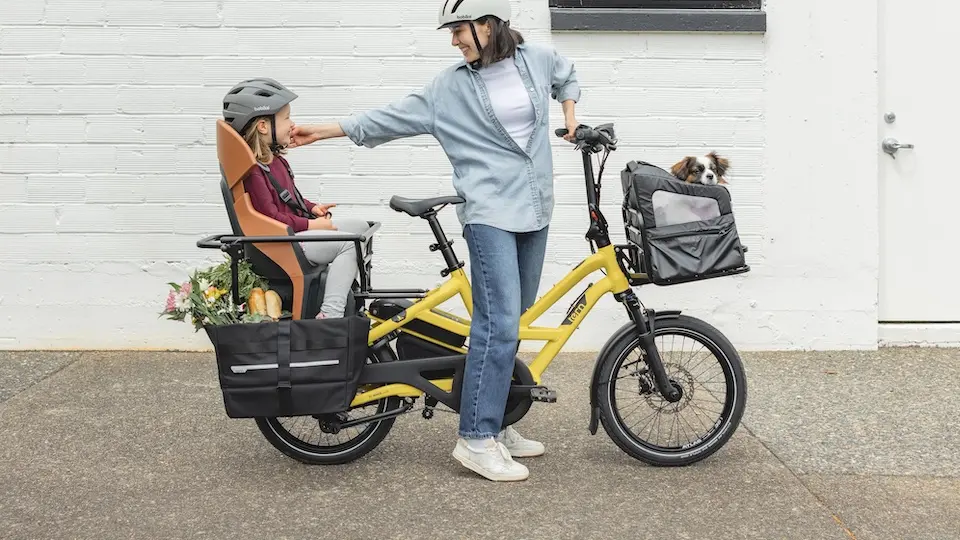
The problem with most cargo e-bikes is not whether they can haul a kid and a week of groceries. It is where you put the thing when you are not riding it. Tern has spent years building compact cargo bikes around exactly that problem, and the all-new HSD Gen 3 is its latest answer: a one-passenger electric cargo bike that Tern says it re-engineered from the frame up while keeping the small footprint that made the HSD popular in the first place.
Tern’s launch release puts the HSD Gen 3 at a starting price of $4,999 in the US, with a claimed maximum gross vehicle weight of 190 kg (419 lb) and a rear rack rated to carry an adult passenger by the numbers. The redesign leans on Bosch’s Gen 5 drive systems and adds parking and folding tricks aimed at people who store a bike in an apartment, a hallway, or a packed garage. It is expected at North American and European bike shops in late summer 2026.
What Tern Actually Announced
The HSD has always been Tern’s shorter, one-passenger cargo bike, the smaller sibling to its longer GSD. For Gen 3, Tern says the frame is completely re-engineered with cargo-focused geometry, a longer wheelbase, and a lower center of gravity. Those three changes are the ones that tend to matter most on a loaded cargo bike, because a low, long, stable platform is what keeps a heavy load from feeling twitchy when you start, stop, and corner.
The headline capability is load. Tern lists a maximum gross vehicle weight of 190 kg (419 lb), which covers the rider, the bike, the battery, and everything you strap to it. The Atlas H rear rack carries a claimed 80 kg (176 lb), which by rating is enough for an adult passenger or a serious cargo load once every other limit and setup requirement is met. Tern also lists a rider fit range of 150 to 205 cm (4 ft 11 in to 6 ft 9 in) and a rider weight maximum of 130 kg (286 lb).
Despite the cargo rating, Tern keeps the footprint small. Electrek reports an overall length of 68.5 inches (174 cm), shorter than a lot of conventional bikes and far shorter than a full longtail. That combination, big load rating in a short frame, is the whole pitch of the HSD, and it is the reason the storage features below are not an afterthought.
Tern HSD Gen 3: what the sources report
data| Spec | What the sources report | Source |
|---|---|---|
| Type | All-new compact one-passenger electric cargo bike | Tern |
| Max gross vehicle weight | 190 kg (419 lb), including rider, bike, and cargo | Tern |
| Rear rack rating | Atlas H rack, 80 kg (176 lb) by rating, enough for an adult passenger or cargo when all limits and setup are met | Tern |
| Rider fit range | 150 to 205 cm (4 ft 11 in to 6 ft 9 in) | Tern |
| Rider weight max | 130 kg (286 lb) | Tern |
| Overall length | 68.5 inches (174 cm) | Electrek |
| Drive system | Bosch Gen 5, described by Tern as lighter, quieter, and more powerful than prior systems | Tern |
| Class (US) | Certain US models are Class 3 with pedal assist to 28 mph; not all models are Class 3 | Tern |
| Safety certification | Electrical system UL 2849 certified; frame and fork tested to EN 17860 at the claimed 190 kg load | Tern |
| Starting price | $4,999 US (EUR 4,899 / GBP 4,300 in Europe and the UK) | Tern |
| Availability | North American and European bike shops in late summer 2026; other markets by year end | Tern |
Bosch Gen 5 and the Class Question
The Gen 3 runs on Bosch Gen 5 drive systems, which Tern says are lighter, quieter, and more powerful than the systems that came before. On a cargo bike, motor quality is not a spec-sheet nicety. A drive unit that delivers smooth, strong assist from a dead stop is what gets a loaded bike moving on a hill or from a stop sign without a lurch, and Bosch’s mid-drive systems have a long track record on cargo bikes for that reason. RoostMode has not ridden this bike, so treat the “lighter, quieter, more powerful” claim as Tern’s, not a verified result.
The class rating is where buyers need to slow down. Tern says certain US models are Class 3, with pedal assist up to 28 mph, and it is careful not to say every model is Class 3. That distinction decides where you can legally ride. A Class 3 bike is faster on a road commute but is restricted from some bike paths and multi-use trails and often carries extra rules on helmets and minimum age, while lower classes get wider trail access. If you are carrying a kid to school on a path that bans Class 3, the class label on the specific model you buy is not a detail, it is the whole decision.
The Four Models, and Why the Drivetrain Differs
Tern is launching four models. The names on the US page are the HSD S9i Sport, HSD P00, HSD P5i, and HSD P10e Sport. They share the frame and the Bosch Gen 5 platform, but the drivetrains differ enough to change how the bike feels day to day, and select models add Bosch eShift for electronic gear changes.
The S9i uses a 3X3 NINE internal gear hub with a 554% gear range, a Gates belt drive, and automatic downshift at stops. That package is aimed at low-maintenance city riding: a belt does not need oil and will not stain your work clothes, the internal hub shifts while stopped, and the auto-downshift means you are never stuck in a high gear when the light turns green with a loaded bike. The P10e Sport goes a different direction with a TRP wireless drivetrain that can shift automatically based on a cadence you select, so the bike holds your preferred pedaling rhythm as terrain changes.
Which one fits depends on how you ride. A belt-and-hub bike like the S9i rewards riders who value low upkeep and clean starts in traffic, while a wider-range derailleur setup can suit riders who want more gearing on steep terrain. This is exactly the kind of tradeoff worth feeling on a test ride rather than guessing from a spec table, and it is why the model you demo should be the model you are actually considering buying.
HSD Gen 3 drivetrain differences worth asking about
data| Model | Drivetrain as reported | Why it matters |
|---|---|---|
| HSD S9i Sport | 3X3 NINE internal gear hub, 554% range, Gates belt drive, auto downshift at stops | Low upkeep, clean starts in traffic, shifts while stopped |
| HSD P10e Sport | TRP wireless drivetrain with automatic shifting based on selected cadence | Holds a chosen pedaling cadence as terrain changes |
| HSD P00 and HSD P5i | Additional models in the launch lineup; select models add Bosch eShift | Confirm the exact drivetrain and class per model at a dealer |
Storage, Parking, and Small-Space Living
The reason to buy a compact cargo bike instead of a full longtail is usually space, and Tern built the Gen 3 to be stored in tight places. Tern lists vertical parking, vertical rolling, and a FlatFold handlepost. In plain terms, you can stand the bike up on its tail to take up a fraction of the floor space, roll it on its rear wheel while it is stood up, and fold the handlepost down so it slides against a wall or into an elevator.
For an apartment dweller or anyone parking in a shared hallway, those features are the difference between a cargo bike that gets ridden and one that becomes a hallway obstacle you resent. A 68.5 inch bike that stands vertically occupies about the footprint of a coat rack. If you have been talked out of a cargo bike because you had nowhere to put it, this is the part of the announcement aimed squarely at you, though you will want to measure your actual space and try the parking motion yourself before assuming it fits.
Safety Certification and Security Features
Tern lists two certifications worth noting. The electrical system is UL 2849 certified, which is the safety standard covering the e-bike’s electrical and battery system as a whole, and battery certification is one of the things worth insisting on with any e-bike. Separately, Tern says the frame and fork are tested and certified to EN 17860 at the claimed 190 kg load, which speaks to whether the structure is rated for the weight it advertises. Both are manufacturer-cited certifications, not RoostMode test results.
On security, the Bosch Smart System includes a Battery Lock and a Report as Stolen function. Tern’s product page also describes eBike Lock, an alarm, and GPS features, but here is the catch that buyers miss: some of those features may require the Bosch ConnectModule hardware and, in some cases, a Flow+ subscription. That means the theft-tracking and alarm capabilities you see in the marketing may not all be included free on every model or forever.
Accessories, and What Is Not in the Price
Tern is launching the Gen 3 alongside an expanded accessory system covering child, passenger, weather, cargo, and pet options. The named pieces include the Clubhouse Mini, Storm Box Mini, Sun Shield Mini, Rain Shield Mini, Sidekick Footrests, and the Hardshell Hauler. That range is part of why families gravitate to Tern: the bike is a base you build onto for school runs, rainy commutes, or hauling a dog.
The thing to keep straight is that accessories are not included in the $4,999 starting price. A child seat, a weather cover, footrests for a passenger, and cargo boxes add up quickly, and a realistic family setup can push the out-the-door cost well past the base number. When you price this bike, price the version you would actually ride, with the accessories your household needs, not the bare bike on the launch page.
Who Should Care, and What to Confirm at a Dealer
The HSD Gen 3 is aimed at the buyer who wants real cargo and passenger capacity but does not have room for a full longtail, and who values a name-brand Bosch drivetrain and dealer support over a cheaper online-only cargo bike. The 190 kg load rating, the compact 68.5 inch length, and the vertical parking are the features that make this a bike a car-light family can live with in a small home. If that is your situation, this is a launch worth watching.
Tern sells the HSD through local dealers rather than direct to consumers, which is a genuine advantage here. It means you can throw a leg over the exact model, feel the drivetrain, try the parking motion, and get the class and security questions answered by a person before you commit. Use our dealer directory to find a shop, and if this would be your first e-bike, our guide to choosing a first e-bike covers what to check on a demo so you are comparing bikes on what matters. If you are weighing the HSD against longer haulers, our cargo and longtail e-bike shortlist is a place to see where a compact cargo bike fits against the bigger options.
What to Confirm Before You Order
Treat this launch the way you would treat any new cargo e-bike, and get the following pinned down before you buy:
- Class of the specific model. Tern says certain US models are Class 3, not all of them. Confirm the assist speed and class label for the exact model and check it against where you ride.
- Security features and subscriptions. Ask which of Battery Lock, Report as Stolen, eBike Lock, alarm, and GPS are included on your model, which need the Bosch ConnectModule, and which need a Flow+ subscription.
- Real out-the-door price. The $4,999 start is the base bike. Price the accessories your household needs, plus tax and fees, for the version you would actually ride.
- Load and fit for your use. The 190 kg gross vehicle weight and 80 kg rack are ratings that assume every other limit and setup requirement is met. Confirm the numbers cover your rider, passenger, and cargo, and that the 150 to 205 cm fit range and 130 kg rider max work for you.
- Availability and service. Tern expects the bike at North American and European shops in late summer 2026, with other markets by year end. Ask your dealer about timing, warranty, and local service before you count on a delivery date.
A re-engineered HSD with Bosch Gen 5, a bigger reworked frame, and better storage is a meaningful update to one of the more sensible cargo bikes on the market. Just make the class and the true, accessorized price the first two things you settle, not the last.
FAQ
FAQ
+How much does the Tern HSD Gen 3 cost?
+How much weight can the HSD Gen 3 carry?
+Is the HSD Gen 3 a Class 3 e-bike?
+What is the difference between the HSD models?
+How do you store a Tern HSD Gen 3 in a small space?
+Does the HSD Gen 3 come with theft protection?
+When can I buy the HSD Gen 3, and where?
RoostMode will pass along more once we can confirm details on specific models, and if we get a chance to ride one, we will say so plainly and separate ride impressions from the launch facts above.
Sources
- Tern launches all-new HSD cargo bike: big upgrades, same compact size (Tern official launch release)
- Tern HSD Gen 3 official US product page
- Tern redesigns famous HSD cargo e-bike, making it smarter, stronger, and even more family-friendly (Electrek, Micah Toll, July 15, 2026)