
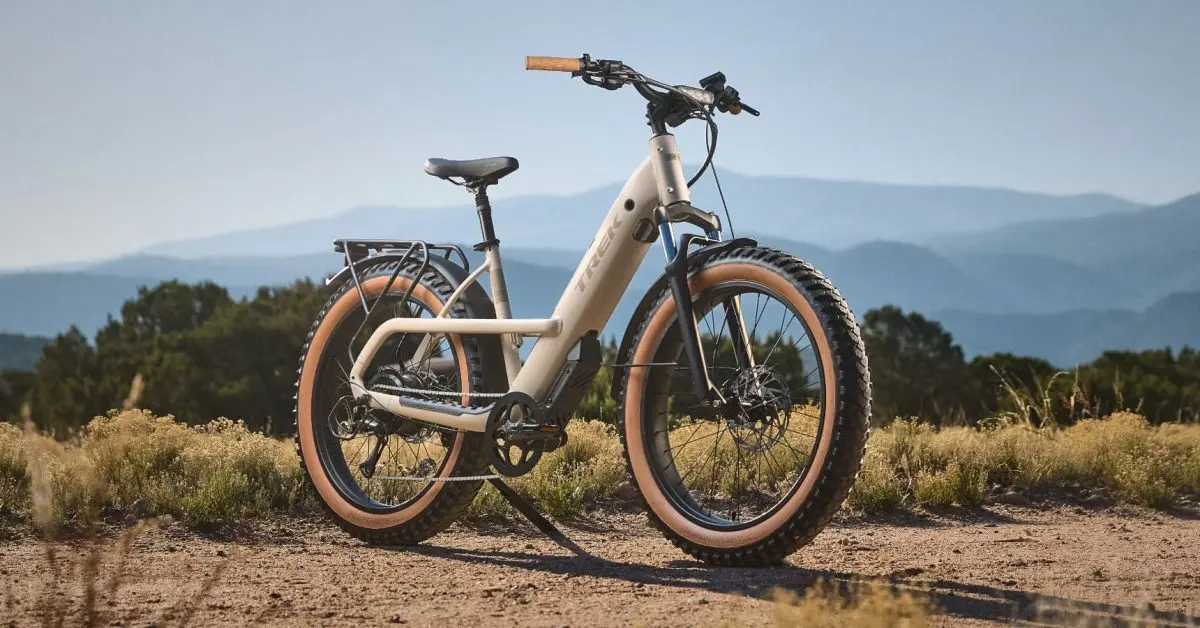
For years, the throttle-enabled fat tire e-bike has been the home turf of direct-to-consumer brands. Order online, unbox it in your garage, and hope you never need warranty service. Trek just walked into that segment with the Borrego+ and Borrego+ S, and the fact that it is Trek changes the shopping math more than any single spec, as reported by Electrek.
Both bikes run a 750W rear hub motor with 90 Nm of torque and a 720 Wh removable battery that Trek claims is good for up to 60 miles of range. The standard Borrego+ is a Class 2 bike, which means 20 mph with pedal assist plus a thumb throttle. The Borrego+ S steps up to Class 3 with a 28 mph top speed.
What Trek Actually Built
The hardware list reads like Trek studied the direct-to-consumer fat tire playbook and matched it item for item: 4 inch tires with puncture protection, an 80 mm suspension fork, an upright riding position, hydraulic disc brakes, integrated lights, fenders, and a rear rack. That is the full commuter-plus-adventure package that brands like Rad Power, Aventon, and Lectric have been selling online for years.
The 750W hub motor and thumb throttle are the notable part. Trek has historically leaned on mid-drive, pedal-assist bikes, and a throttle-enabled hub motor bike is a clear signal that the company wants the buyers it has been losing to online brands. The 720 Wh removable battery is a practical touch too, since charging inside while the bike stays in the garage is how most people actually live with these bikes.
Electrek reports launch pricing at $2,699.99 for the Borrego+ and $2,999.99 for the Borrego+ S. Check the source article linked below or a Trek dealer for current out-the-door numbers before you compare, since promotional pricing in this segment moves around.
The Dealer Question Is the Real Story
Here is the trade shoppers in this segment have always faced. Direct-to-consumer fat tire bikes tend to cost less for the spec sheet you get. What you give up is a human being who will look at your bike when something goes wrong. Warranty claims happen over email, replacement parts ship to your door, and you either wrench on it yourself or find a local shop willing to work on a brand it does not carry. Plenty of shops decline.
A Borrego bought through a Trek dealer comes with the opposite arrangement. Assembly, fit, first service, and warranty work all happen at a physical shop. If a controller dies or a brake needs bleeding in year two, you have somewhere to take it. For a heavy fat tire bike that is a bigger deal than it sounds, because shipping one back to an online brand for service is expensive and slow.
That does not automatically make the Trek the right call. If you are comfortable with basic maintenance and the price gap is large, a direct-to-consumer bike can still be the better value. But if you are buying for someone who will never touch a torque wrench, dealer support is worth real money. Our dealer directory can help you check what is actually near you, because a dealer network only helps if there is a dealer in your area.
Class, Speed, and the California Catch
The two models sit in different legal categories, and that matters more than the 8 mph difference suggests. The Class 2 Borrego+ is legal on most bike paths and trails that allow e-bikes. The Class 3 Borrego+ S is faster but faces more restrictions on multi-use paths, and some states and cities regulate Class 3 bikes differently. If the distinction is fuzzy, our guide to e-bike classes 1, 2, and 3 covers what each class means in practice.
There is also a hard stop for one group of buyers: Electrek reports that the Class 3 Borrego+ S will not be sold in California due to state regulations. If you live there, the standard Borrego+ is the only version on the table. Wherever you live, check your state’s rules before choosing between the two, since class-based restrictions vary widely. Our state-by-state breakdown of e-bike laws in 2026 is the place to start.
What to Verify Before You Buy
Treat this launch the way you should treat any new e-bike, from Trek or anyone else:
- Class and local legality. Confirm which class you are buying and whether your city, trail system, or state restricts it. The California exclusion on the Borrego+ S shows this is not theoretical.
- Range claims. Up to 60 miles means up to. Throttle use, rider weight, hills, cold weather, and 4 inch tires all pull real-world range well below the headline number. Plan around the low end for your riding, not the maximum.
- Service reality. Ask the dealer what warranty work on the Borrego actually looks like, including turnaround time and whether the shop stocks parts. Dealer-backed only helps if the dealer delivers.
- Fit. Fat tire bikes are big, heavy machines. An upright position helps, but test the standover height, reach, and whether you can move the bike around your storage space before committing.
- Total price. Compare the out-the-door dealer price against direct-to-consumer competitors with similar specs, then decide whether the support difference justifies the gap for you.
Trek showing up in this segment is good news for shoppers either way. It validates the throttle fat tire category, gives buyers a dealer-backed option where there mostly was not one, and puts pricing pressure on everyone. If you are earlier in your research, our electric bike guides cover the fundamentals before you start comparing spec sheets.