
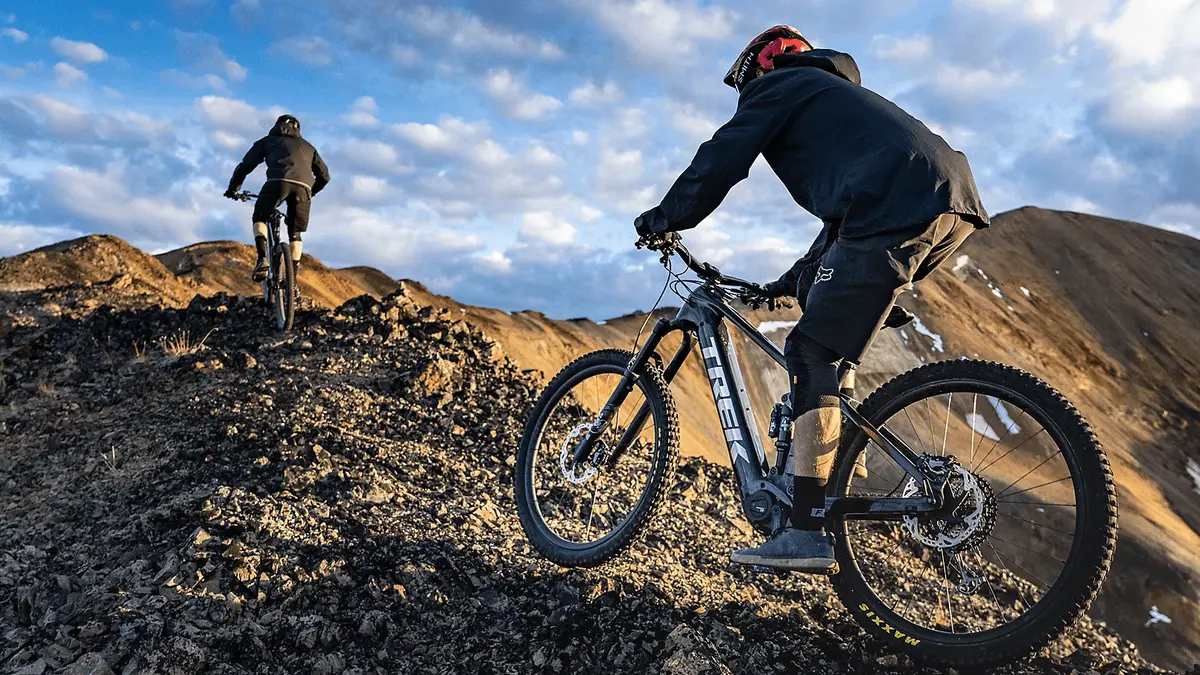
Trek just voluntarily capped its US electric mountain bikes at Class 1, the most restricted of the three e-bike classes. As reported by BikeRadar on July 27, 2026, Trek is restricting its US electric mountain bikes to Class 1 operation only, meaning 20 mph pedal-assist with no throttle, and the company is asking the rest of the industry to do the same.
That is not a small tweak to a spec sheet. It is a bike brand restricting its own eMTB lineup and staking that decision on an argument about trail access rather than performance. According to BikeRadar, Trek president John Burke framed it as an access problem: “As an industry, we’ve worked for decades to earn access to trails and bike paths. We’d rather lead with responsibility today than explain tomorrow why riders lost access to the places they love and to a sport that makes the world a better place.”
Here is what the reported policy covers, and what a rider shopping an eMTB or a fast pavement e-bike should take from a policy that is voluntary, brand-specific, and not a change in law.
What Trek Actually Changed
The policy splits cleanly along two product lines, and the split matters because it is easy to conflate “eMTB” with “e-bike” when they are not treated the same way here.
eMTBs: Class 1 Only, No Throttle
Per BikeRadar, Trek will now sell only Class 1 electric mountain bikes in the US. That means 20 mph top assisted speed and no throttle-operation option at all. A rider gets motor help only while pedaling, capped at 20 mph, full stop. BikeRadar’s report describes this as what Trek says it will sell going forward, not a statement about any other class of eMTB.
Pavement Bikes: Class 1 and Class 3 Continue
BikeRadar reports Trek will continue selling Class 1 pavement e-bikes alongside Class 3 models, which are speed limited to 28 mph with throttle assistance available up to 20 mph. Per BikeRadar, the new ceiling applies specifically to bikes built and marketed for trail riding, not to bikes meant for bike paths and roads.
If you’re not sure how Class 1, 2, and 3 differ in the first place, our guide to e-bike classes 1, 2, and 3 breaks down what each one legally allows before you shop.
Why Trek Says It’s Doing This
BikeRadar’s reporting lays out Trek’s reasoning as a trail-access argument, not a performance or cost argument. Trek claims faster eMTBs increase the risk of conflict between trail users and add pressure for new restrictions on where ebikes can ride at all. Per BikeRadar, Trek is betting that a self-imposed limit today protects trail access longer term.
Trek points to a concrete data point to back that up: according to BikeRadar, Trek says more than 17,000 additional miles of US mountain bike trails were opened to eMTBs in 2025. That is the access Trek says it is trying to protect. The company’s stated fear is that ever-more powerful and faster eMTBs could eventually erode that progress, both for ebike riders and for riders of conventional, non-motorized mountain bikes who share the same trail systems.
It’s worth being precise about what this argument is and isn’t. Trek is describing a risk it wants to get ahead of. BikeRadar’s report doesn’t claim the policy has been proven to reduce trail conflicts or improve safety outcomes, and neither does this article. It’s a bet about industry politics and land-manager relationships, framed by Trek as a responsibility argument.
Where Trek Draws Its Regulatory Line
The more interesting part of Trek’s position, per BikeRadar, is where the company thinks the line between “e-bike” and something else should sit. According to BikeRadar, Trek’s stated view is that ebikes offering throttle assistance beyond 20 mph, or a motor-assisted top speed faster than 28 mph, shouldn’t be allowed on bike paths under e-bike rules. Trek argues machines built to those higher assisted speeds should sit in a separate regulatory category entirely, away from bike-path access.
That’s a direct entry into a debate this site has covered before around where fast, powerful two-wheelers stop qualifying as bicycles under most state laws. Trek’s position, as reported by BikeRadar, is that a motor capable of throttling past 20 mph or an assisted top speed above the 28 mph Class 3 cap belongs in that separate category rather than sharing bike-path access with pedal bikes. Our guide on the e-moto classification problem covers how that same line gets drawn state by state, often with very different results depending on where you live.
What This Means for Your Next Bike
If you’re shopping an eMTB or a fast pavement e-bike right now, the practical question is simple: does Trek’s new ceiling change what you should buy?
Does Trek's Class 1 eMTB policy change your shopping list?
quick pick| If you… | Pick | Why |
|---|---|---|
| you ride singletrack and want maximum assisted speed or a throttle off-road | Look outside Trek's eMTB lineup for now | Per BikeRadar, Trek's US eMTBs are Class 1 only going forward: 20 mph cap, no throttle. If you want a faster or throttle-equipped eMTB, Trek's current lineup won't offer one. |
| you want a fast commuter or road e-bike with throttle assist | Trek says it will continue selling its Class 3 pavement bikes | Per BikeRadar, Trek says it will continue selling Class 1 and Class 3 pavement e-bikes, the latter at 28 mph with throttle to 20 mph. The new Class 1-only rule applies to Trek's eMTBs. |
| you already own a Class 2 or Class 3 Trek eMTB | This policy describes future sales, not existing bikes | BikeRadar's report describes what Trek says it will sell going forward. It doesn't address bikes already sold or in riders' hands, so don't read anything here as a claim about what happens to yours. |
| you care about long-term trail access more than top speed | Trek's Class 1 argument is worth weighing | BikeRadar reports Trek ties the policy to more than 17,000 miles of US trail access opened to eMTBs in 2025, and frames the limit as protecting that access. That's Trek's stated reasoning, not a proven outcome. |
What to Verify Before You Buy
Treat this the way you’d treat any manufacturer policy announcement: read past the headline before it changes your decision.
- Check what class you’re actually buying. If trail access matters to you, confirm whether the specific Trek eMTB you’re looking at is sold as Class 1, and whether your local trail system’s rules even distinguish between classes in the first place.
- Don’t assume other brands will follow. BikeRadar reports Trek is calling on other ebike makers to adopt similar limits, but that’s a request, not an industry-wide commitment. Check each brand’s current lineup rather than assuming a Trek-style cap applies elsewhere.
- Separate the pavement and trail decisions. Trek’s Class 3 pavement bikes, at 28 mph with throttle assist to 20 mph per BikeRadar, are a completely different purchase than a Class 1 eMTB. Don’t let news about one confuse your shopping for the other.
- Check your own state and trail rules regardless. Manufacturer policy doesn’t override local law. Our state-by-state e-bike law guide is the place to confirm what’s actually allowed where you ride.
This is a policy story, not a product launch. BikeRadar’s report doesn’t establish that Class 1 eMTBs are safer in practice than eMTBs in other classes. What it does show is that at least one major manufacturer is willing to sell a slower product on a bet that it protects access longer term. Whether that bet pays off, and whether other brands follow, is a story to watch rather than one that’s settled.