
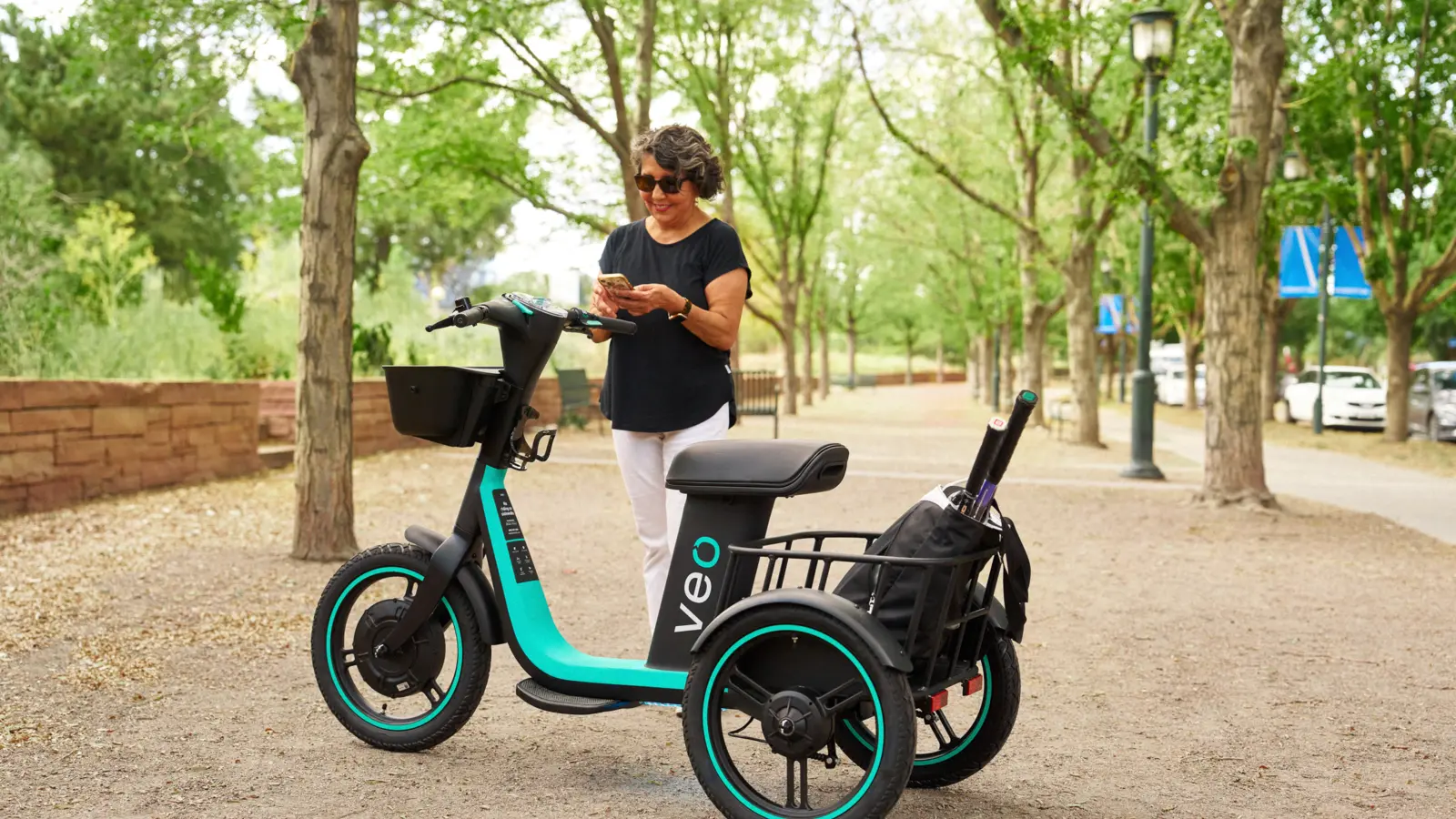
Shared micromobility has spent a decade assuming the rider can balance on two wheels, swing a leg over a frame, and stand up while moving. Veo just put 50 vehicles on the street in downtown Denver that assume none of that.
Veo announced the Rover on July 28, 2026: a three-wheeled shared electric trike with a low, seated riding position, a cushioned seat, throttle assist, front and rear baskets, and a top speed set at 10 mph. Veo describes it as North America’s only shared electric trike. That is the company’s characterization, not something established by independent verification, and it is worth reading as a positioning claim rather than a settled fact.
The launch is deliberately small. Fifty units, downtown Denver only, with Veo saying it will watch rider feedback and day-to-day operations before deciding whether to expand citywide. What follows is what a Denver rider can act on today, and the list of operational details Veo has not published yet.
What Veo Actually Announced
The vehicle itself is described in fairly plain terms. Three wheels instead of two. A low, stable riding position with a cushioned seat rather than a saddle you perch on. Throttle assist, though the announcement does not spell out how the throttle behaves or how it relates to pedaling, so do not assume either way before you look at the vehicle. Baskets front and rear, which Veo says can carry up to 100 pounds.
Be careful with that 100 pound number. Veo’s announcement is not perfectly explicit about whether the figure describes each basket or the two combined, so the honest reading is that 100 pounds is the ceiling somewhere in that system, not a per-basket guarantee. If you are planning a grocery run around it, treat the lower interpretation as your working assumption until Veo clarifies.
The 10 mph cap is the number that shapes everything else. It is half the 20 mph ceiling that Class 1 and Class 2 e-bikes are built to. Veo does not explain the reasoning behind the number, but reading it as a choice aimed at approachability rather than a shortfall is at least consistent with how the company describes the vehicle.
What the announcement does not say is where a Rover may be ridden. Bike lanes, paths, sidewalks, and general traffic lanes are governed by Denver rules and by Veo’s own terms, and neither source publishes how the Rover is classified or where it is permitted. Treat the posted rules in the app and on the vehicle as the answer, and do not assume a Rover is allowed anywhere a Veo scooter or e-bike is.
Veo Rover: what is stated, and what is not
data| Item | What is stated | Source |
|---|---|---|
| Layout | Three wheels, low and stable riding position, cushioned seat | Veo announcement |
| Assist | Throttle assist | Veo announcement |
| Top speed | Set at 10 mph | Veo announcement |
| Cargo | Front and rear baskets, stated as carrying up to 100 pounds; the announcement is not explicit on whether that is per basket or combined | Veo announcement |
| Fleet size | 50 units at launch | Veo announcement |
| Service area | Downtown Denver; exact zone boundaries not published | Veo announcement |
| Denver context | Five Veo vehicle types and roughly 9,000 Veo shared vehicles in the city | Veo claim |
| Price to rent | Not stated | Not in either source |
| App and payment requirements | Not stated | Not in either source |
| Rider weight limit | Not stated | Not in either source |
| Dimensions | Not stated | Not in either source |
| Parking rules | Not stated | Not in either source |
| Where it may be ridden | Not stated; no vehicle classification or lane, path, or sidewalk permission published | Not in either source |
| Battery, range, and braking details | Not stated | Not in either source |
| Weather or surface restrictions | Not stated | Not in either source |
| Expansion timing | No date; Veo says it will assess feedback and operations first | Veo announcement |
Why a Slow Seated Trike Is an Interesting Bet
The case for the Rover is not speed or range. It is the size of the group that current shared fleets quietly exclude.
Veo says 24 percent of respondents to its 2025 annual rider survey identified as having a disability. That is Veo’s own survey of its own riders, so read it as the company’s demand signal rather than a population statistic, but it is a large enough share to explain why a company would spend more than two years building a different vehicle.
The development timeline supports that framing. Veo says work began in early 2024 and involved hundreds of riders along with more than 20 organizations, including the Disability Mobility Initiative, the Parkinson’s Foundation, New Disabled South, and Capitol Hill Village. Consulting disabled riders during design is not the same as proving the result works, but it is a meaningfully better starting point than shipping a two-wheeler and hoping.
Electrek’s Micah Toll, reporting the same day, frames the three-wheel layout as improving balance and points to the errand-running utility of a vehicle with real cargo space. Toll also flags the operational catch: trikes take up more room than bikes or scooters, which makes parking and fleet management a bigger deal than they are for a scooter fleet. That is the publication’s read, and it is a fair one.
What Veo Has Not Published, and Why It Matters Today
The gap between an announcement and a usable vehicle is made of small operational facts, and this announcement leaves most of them out.
There is no rental price. There is no statement about what the app requires to unlock a Rover, or whether payment or account requirements differ from Veo’s other vehicles. There are no dimensions, no rider weight limit, and no exact service zone boundary, which is the single most practical omission for a downtown-only launch. There are no published parking rules, and given Electrek’s point about the physical footprint, parking is exactly where a trike fleet is most likely to run into friction with sidewalks, corrals, and city rules.
Battery details, braking details, and weather or surface guidance are also absent, and so is any statement about where a Rover may legally be ridden. And there is no expansion date. Veo has said only that it will assess rider feedback and day-to-day operations before deciding on citywide expansion, which means a rider outside downtown has no timeline to plan around.
None of this makes the launch suspect. Fifty units is a pilot, and pilots are how you find out what the operating rules should be. It does mean the app is your source of truth right now, not the press release.
Should You Try One?
Is the Rover worth a look for your situation?
quick pick| If you… | Pick | Why |
|---|---|---|
| you are in downtown Denver and want to see whether a seated trike works for you | Worth trying | Fifty units in a defined downtown area is exactly the low-commitment way to find out. Check the app for the live service zone before you plan a trip around it. |
| balancing a two-wheeler is the thing keeping you off shared bikes | The most relevant option Veo has offered | Three wheels and a seated position are the design response to that specific barrier, and Electrek characterizes three wheels as improving balance. Try it somewhere quiet first, because a trike steers and corners differently from a bike. |
| you need to carry groceries or a few bags on a short trip | Reasonable fit | Front and rear baskets with a stated capacity up to 100 pounds cover errand-sized loads. Confirm the posted limit on the vehicle itself, since the announcement is not explicit on per basket versus combined. |
| your route includes fast arterials or long distances | Look at something else | A 10 mph top speed is half a Class 1 e-bike's ceiling. Neither source says where a Rover may be ridden, so check the posted operator and city rules, and treat a large speed gap with surrounding traffic as a reason to pick a different route. |
| you live outside downtown Denver | Nothing to plan around yet | The launch is downtown only, and Veo has published no expansion date. It says it will evaluate feedback and operations first. |
| you are deciding between renting and buying for regular use | Rent first, then price ownership | A pilot fleet is a cheap way to test whether the format suits you before spending on a vehicle of your own. |
| you have a specific medical or mobility condition in mind | Talk to your own clinician | Neither source establishes medical suitability, and no article can assess your situation. Design consultation with disability organizations is not a substitute for individual advice. |
A First-Ride Checklist
If you are going to try one, the sequence below costs a few minutes. It is general shared-vehicle caution rather than Rover-specific guidance, because Veo has not published rider instructions, and none of it substitutes for the rules posted in the app and on the vehicle.
- Open the Veo app before you leave. Confirm the live service zone, the price to unlock and per minute, and whatever account or payment setup is required. None of that is in the announcement, so the app is the only current source.
- Inspect the vehicle before you unlock it. Squeeze the brakes and check that they engage. Look at the tires for obvious flats or damage. Check that the seat is secure and the baskets are attached and not bent.
- Start slowly in an open, low-traffic spot. A trike steers and corners differently from a bike, and Veo has published nothing about how this one handles. Give yourself somewhere a wide or clumsy line costs you nothing while you find out.
- Load cargo low and secured, within the posted limit. Read the limit printed on the vehicle rather than relying on the announcement. Where you put a load can change how the vehicle feels to steer, so add weight gradually and test at low speed before committing to a route.
- Confirm the local riding and parking rules first. Where you may ride and where you may leave the vehicle are set by Denver and by Veo’s own terms, not by the press release, and the announcement publishes neither the parking rules nor where a Rover is permitted to operate. Follow what the app and the vehicle tell you. Our state e-bike law guide covers how riding rules are structured generally, though it does not cover this vehicle, and shared-fleet operating rules are set locally and by the operator.
The Bigger Question the Pilot Is Testing
Shared fleets are usually judged on trips per vehicle per day. A vehicle like this may not win that metric, and that may not be the point.
If the Rover works, it widens who counts as a shared-mobility rider, and the interesting result will not be the ride quality. It will be whether Veo publishes the operational facts a rider needs, whether the parking footprint Electrek flagged turns out to be manageable on real sidewalks, and whether the riders the design was built for actually keep using it after the novelty passes.
Our read of the published announcement and reporting, not a test of our own: this is a well-aimed pilot with an unusually thin public spec sheet. Fifty units in one downtown is the right size for finding out what breaks. The 10 mph cap and the seated three-wheel layout read as coherent choices for the job the company describes. And the things a rider most needs to know, price, zone, weight limit, parking rules, and where the thing may be ridden, are the things Veo has not said yet. If you are in downtown Denver, the app will answer those faster than any article can.
FAQ
FAQ
+Has RoostMode ridden the Veo Rover?
+Where can I ride a Rover, and what does it cost?
+How fast does the Rover go, and is 10 mph enough?
+How much can the baskets carry?
+Is the Rover accessible, and will it work for my mobility needs?
+Will Veo expand the Rover beyond downtown Denver?
+What are the biggest unanswered questions about this launch?
Sources
- Veo launches shared electric trike, expanding access to micromobility (Veo, July 28, 2026), the source for the launch details, fleet size, feature list, development history, survey figure, and Denver fleet context.
- You’ve heard of shared e-bikes, now check out Veo’s new shared e-trike (Electrek, Micah Toll, July 28, 2026), the source for the balance and errand-utility framing and the point about trike footprint affecting parking and fleet management.
- Hero image: Veo official Rover press photo, published with Veo’s July 28, 2026 announcement. Cropped and optimized by RoostMode.