West Virginia did not change its e-bike law in 2026. The rules riders follow today were last rewritten in 2023 (House Bill 2062), and the one e-bike bill filed this year, a sweeping trail-management proposal, never got past its first committee referral. So this is not a story about something new. It is a plain guide to what the West Virginia Code actually says, for anyone buying an e-bike for themselves or a teenager, or planning a ride on one of the state’s rail-trails.
What Counts as an E-Bike in West Virginia
Section 17C-1-70 defines an electric bicycle as a two- or three-wheeled vehicle with fully operable pedals and an electric motor of fewer than 750 watts. It then sorts them into the familiar three classes:
- Class 1: the motor helps only while you pedal and stops at 20 mph.
- Class 2: the motor can propel the bike by itself through a throttle, and stops helping at 20 mph.
- Class 3: pedal-assist only, cutting out at 28 mph. Class 3 bikes must have a speedometer.
The motor must disengage when the rider stops pedaling, or when the rider brakes and stops pedaling. Bikes must meet the federal bicycle standard in 16 CFR Part 1512. For a fuller explanation of the classes, see our e-bike classes guide.
No License, No Registration, but No Tampering
Under Section 17C-11-8, an e-bike rider has the same rights and duties as the driver of a vehicle, except where the e-bike section says otherwise. E-bikes are exempt from the state’s registration, title, driver’s license and financial responsibility laws.
The law is unusually direct about modifications. You may not tamper with an e-bike to change its motor speed or switch it between pedal-assist and throttle. If a motor is modified so the bike exceeds the limits in the definition, it is no longer an electric bicycle under state law. There is one exception: a modified bike ridden only on your own property.
That line matters for anyone eyeing an “unlocked” bike or a high-powered machine like those in our electric dirt bikes hub. Once it is outside the definition, the e-bike exemptions no longer apply to it.
Helmets and Age
Anyone under 15 riding an e-bike, as the operator or a passenger, must wear a properly fitted and fastened bicycle helmet under the state’s Child Bicycle Safety Act.
The e-bike section sets no minimum age to ride any class. And riding a Class 1, 2 or 3 e-bike under the influence of alcohol or controlled substances is prohibited.
Where You Can Ride
The default in Section 17C-11-8 is equal treatment. Class 1 and Class 2 e-bikes may use roads and trails where traditional bicycles are allowed, with the same rights and duties. The statute says the goal is to open access to public lands for people with disabilities, health issues or age-related limits.
The limits:
- Class 3 may not be ridden on a bicycle path, multiuse trail or single-use trail unless that path is within a highway or roadway, or the city, local authority or state agency in charge expressly allows it.
- No special access. E-bikes may not go anywhere ordinary bicycles are banned.
- Private land is up to the owner.
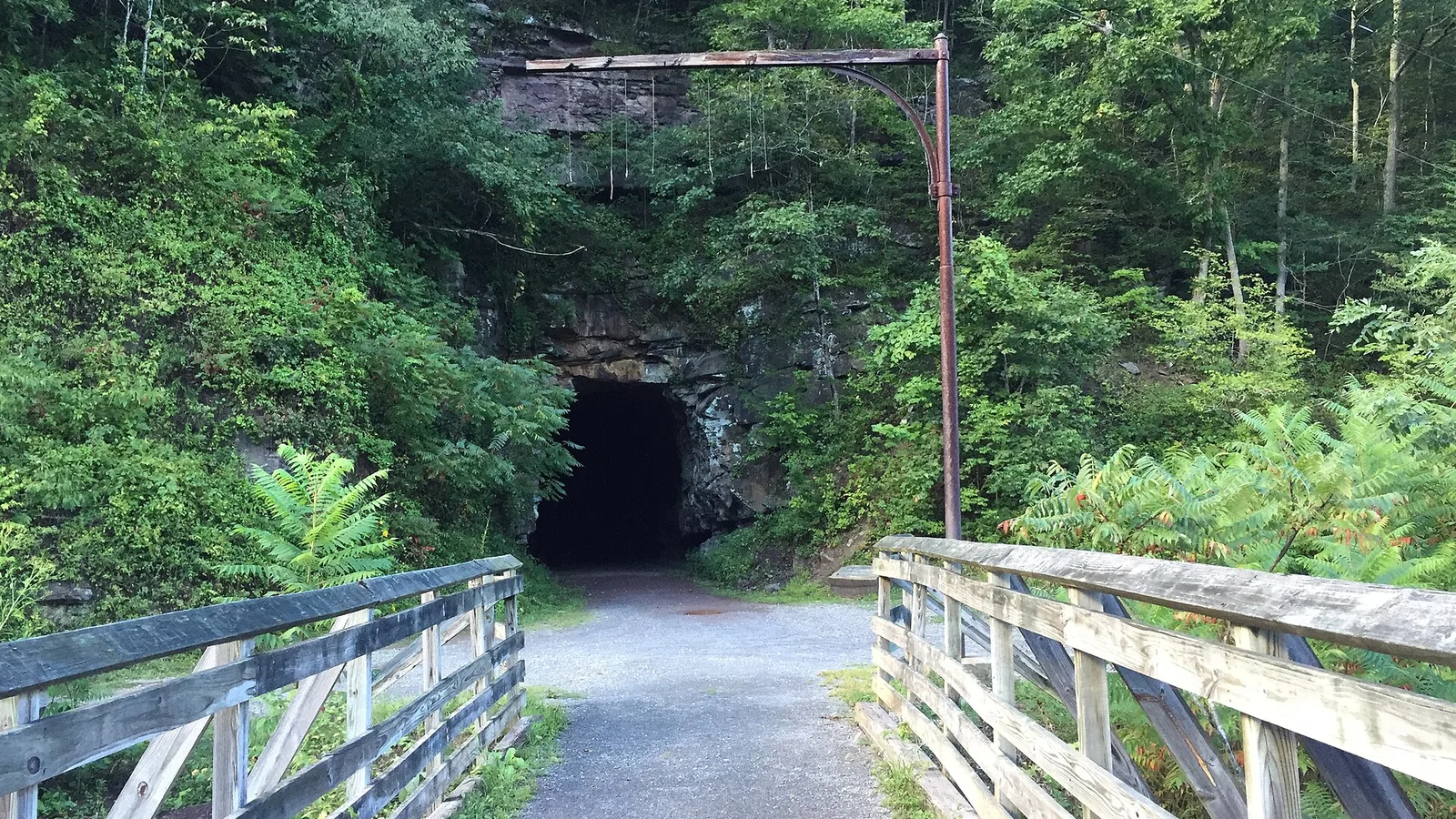
The Greenbrier River Trail. West Virginia State Parks’ page for the 78-mile Greenbrier River Trail lists Class 1, 2 and 3 as permitted and repeats the under-15 helmet rule. Since the statute lets the agency in charge expressly allow Class 3 on a trail, that listing reads as this trail’s permission. Other state trails and parks may differ, so check each one’s page.
The 2026 Bill That Stalled
Senate Bill 485, introduced January 19, 2026, by Sen. Woodrum, proposed a “Behavior-Based E-Bike and Multi-Use Trail Mobility Act.” Instead of sorting bikes by class and wattage, it would have grouped every device on a public multi-use trail by how it behaves: human-powered and pedal-assist bikes, low-impact motor-assist with limited throttle, and anything that can keep moving without pedaling. It proposed default trail speed limits (12 to 15 mph on narrow natural-surface trails, 20 mph on paved paths), a yield order with horses first, civil fines starting at up to $25, and Division of Natural Resources rules and signs.
The legislature’s record shows the bill was referred to the Senate Transportation and Infrastructure Committee, and then Finance, on the day it was filed, with no action after that. It was not enacted, so none of those rules apply.
What Riders and Parents Should Check
- Helmet for anyone under 15. That includes kids riding as passengers.
- Do not unlock or modify the bike. A modified bike that exceeds the limits is no longer a legal e-bike on public roads and trails.
- Class 3 and trails: look for express permission from the trail manager, as on the Greenbrier River Trail.
- Read the trail’s own page before a trip, since managers set the details.
You can compare West Virginia with nearby states in our state-by-state e-bike law guide, and the West Virginia dealer page lists local shops.
What’s Next
The 2027 regular session opens in January. If trail-use ideas like SB 485 come back, we will cover them. Until then, Sections 17C-1-70 and 17C-11-8 remain the rules.
Sources
- W. Va. Code § 17C-1-70, electric bicycle definitions
- W. Va. Code § 17C-11-8, electric bicycle requirements and restrictions
- W. Va. Code § 17C-11A-1, Child Bicycle Safety Act
- SB 485 (2026) status, West Virginia Legislature
- SB 485, introduced text
- Greenbrier River Trail activities, West Virginia State Parks