
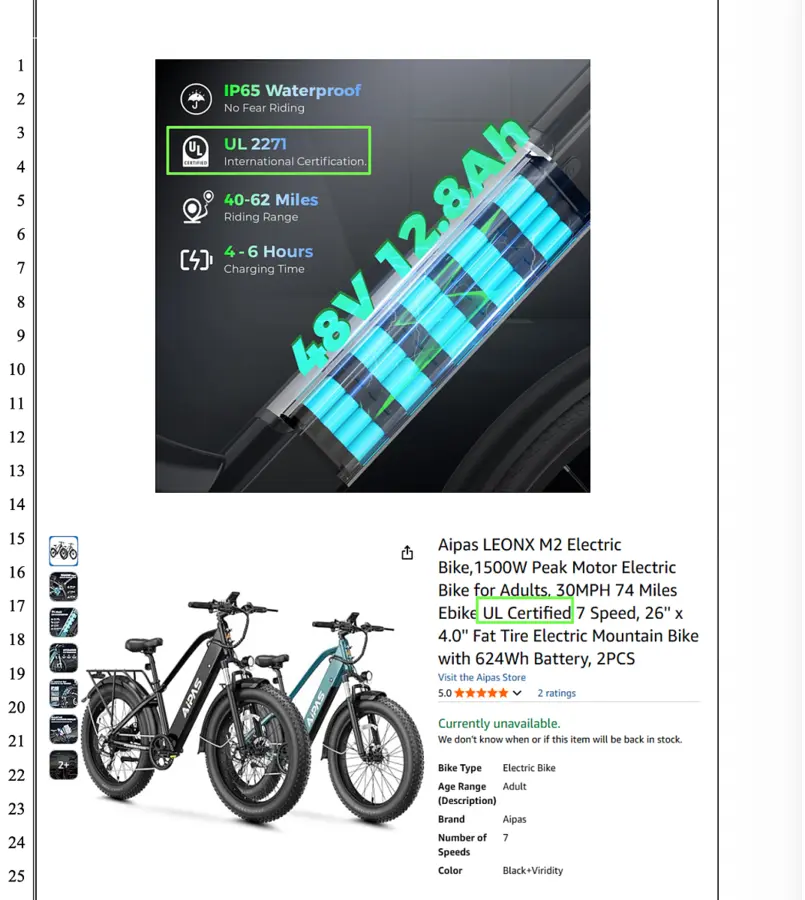
A lawsuit filed by Amazon and UL against five e-bike and e-scooter companies over allegedly fake UL certification claims has ended with a court order barring the companies from doing it again. Bicycle Retailer & Industry News reports that U.S. District Judge Jamal N. Whitehead of the U.S. District Court for Western Washington in Seattle signed a consent judgment and permanent injunction on Monday.
For riders, this is less about the courtroom and more about a basic trust problem: some products sold online have carried safety certification marks they did not earn. This case shows the marketplace and the certifier pushing back, and it is a useful moment to sharpen how you shop.
What Happened
According to the Bicycle Retailer & Industry News report, Amazon and UL filed suit on January 23 against three Chinese companies, one Hong Kong-based company, and one individual, alleging counterfeit and trademark infringement. The defendants were Jiangmen Meijiasheng Bicycle Co., Ltd.; Shenzhen Aibosi Sport Technology Co., Ltd.; and Guangzhou Aierfeile Sport Technology Co., LTD., all of China; Hong Kong Manchester International Trading Co., LTD., of Hong Kong; and Tang Shuhui, an individual.
The complaint listed seven specific models offered for sale on Amazon under the Aipas and A4 brands, and alleged that some models improperly bearing the UL trademarks were also sold on aipasbike.com.
The consent judgment resolves the claims of trademark counterfeiting, trademark infringement, and false designation of origin in favor of Amazon and UL, and dismisses other claims with prejudice. The permanent injunction bars the companies from importing, manufacturing, producing, distributing, circulating, offering to sell, promoting, or displaying any product or service using any simulation, reproduction, counterfeit, copy, or colorable imitation of UL’s certification marks or service marks, in any store or in any medium. It also bars them from aiding any other person or business doing the same. Under the settlement, each side pays its own legal fees and costs.
The complaint put the stakes plainly. According to the filing, the defendants “willfully deceived and harmed Amazon, UL, and their customers; compromised the integrity of the Amazon Store; and undermined the trust that customers place in Amazon and UL.”
Why UL Certification Claims Matter for E-Bike Buyers
A UL certification mark on an e-bike or e-scooter is supposed to mean the product’s electrical system or battery was tested against an established safety standard by an independent lab. Buyers lean on that mark because most people cannot evaluate a battery pack or charger themselves. It is the shorthand that separates a product with verified engineering from one that just looks the part.
That is exactly why a counterfeit mark is worse than no mark at all. A missing certification tells you to ask questions. A fake one answers those questions with a lie, and it does it on the product category where the downside is a lithium battery fire in your garage or apartment. Certification fraud does not just hurt the buyer of that specific bike. It erodes the value of the mark for every honest brand that paid for real testing, and it makes the whole comparison process harder for everyone.
This case also lands in a broader shift toward taking e-bike electrical safety seriously at the federal level. We covered the CPSC’s proposed federal battery safety rule, which would make compliance with UL standards a legal requirement rather than a marketing choice. If that direction holds, certification marks will carry even more weight, which makes policing fake ones more important, not less.
What Shoppers Should Check Before Buying
You do not need to become a compliance expert, but a few habits go a long way:
- Look for the specific standard, not just a logo. A listing that names the actual standard its electrical system or battery was certified to is a better signal than a badge graphic with no details.
- Check the certifier’s own database when you can. Certification bodies maintain public directories of certified products. If a brand claims certification, the claim should be verifiable somewhere other than the product listing.
- Weigh the brand, not just the listing. An established brand with a real support operation, published documentation, and a track record has more to lose from a fake claim than a storefront that appeared last quarter.
- Be skeptical of too-good pricing paired with big safety claims. Real third-party testing costs money. A rock-bottom price and a wall of certification badges is a combination worth questioning.
- Keep records. Save the listing, the claimed certifications, and your receipt. If a claim later turns out to be false, that paper trail matters.
None of this guarantees a safe product, but it stacks the odds in your favor and makes you a harder target for the kind of deception this suit describes.
What Marketplace Enforcement Still Cannot Do
It is worth being clear-eyed about the limits here. This injunction binds the five named defendants. It does not scan the rest of the marketplace for the next seller who prints a certification mark they did not earn. Enforcement of this kind is reactive by nature: a false claim has to be found before it can be stopped, and products may sell in the meantime.
A court order also cannot make an uncertified product safe. Barring a company from using a counterfeit mark addresses the deception, not the engineering underneath it. And injunctions against specific companies do not, by themselves, resolve what happens for people who already bought the products in question.
That is why the buyer-side habits above matter. Marketplace and legal enforcement raise the cost of faking certifications, and that is genuinely good news. But the last line of defense is still an informed buyer who verifies claims instead of trusting badges.