
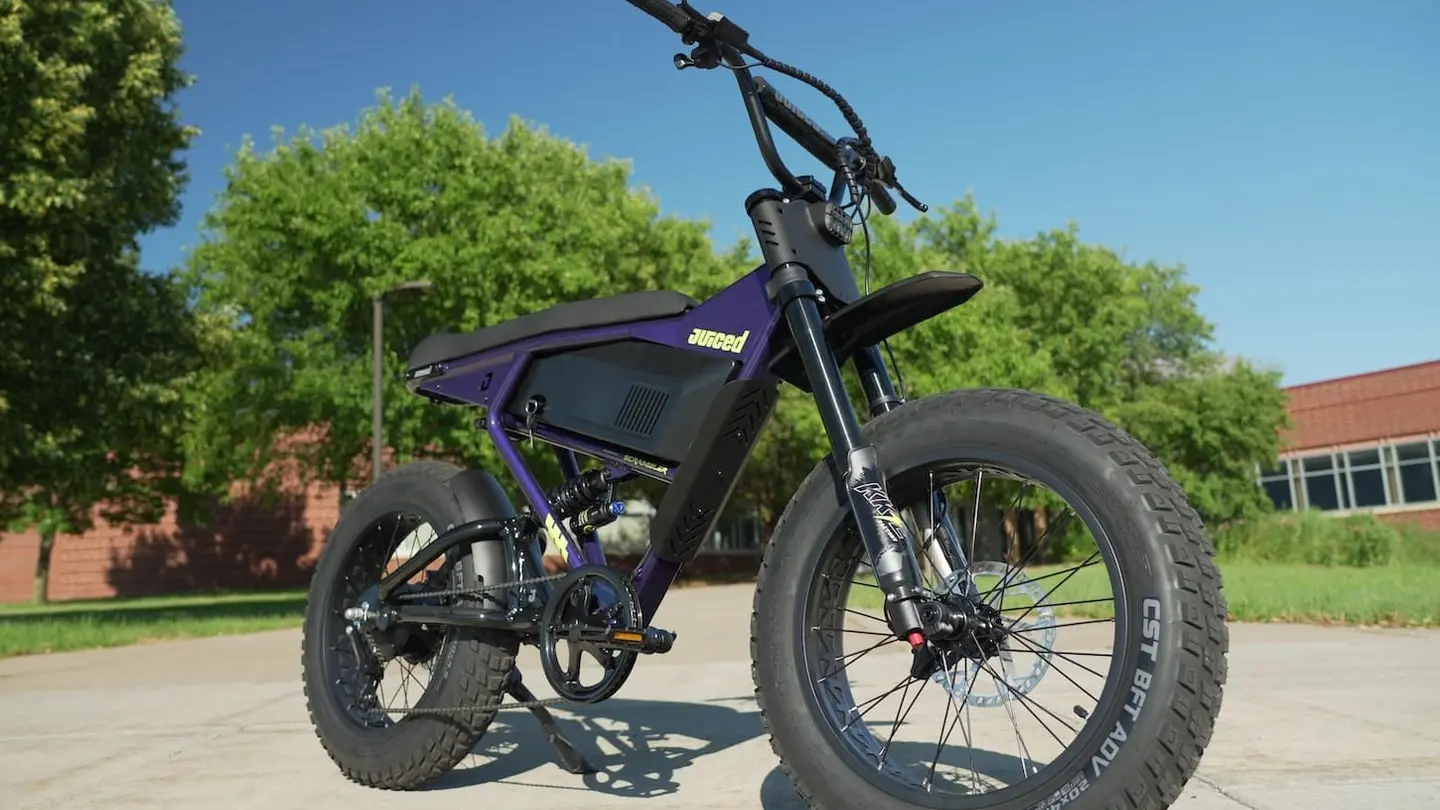
The most interesting thing about the Juiced Scrambler is not the motor or the price. It is that the badge on the frame belongs to a company that collapsed in 2024. Electrek reports that Juiced is back under new ownership, and separately links to its own earlier reporting that Lectric acquired the brand. That is Electrek’s reporting, not something RoostMode has independently confirmed, and it is the single fact that should shape how you read every other spec on this bike.
A relaunch changes what a spec sheet is worth. A 750W-rated hub motor and quad-piston brakes mean one thing from a company with unbroken service history behind it, and something else from a nameplate that just came back. The hardware can be good and the support question can still be open.
RoostMode has not ridden the Scrambler. Every ride impression below belongs to Micah Toll, who wrote Electrek’s July 30, 2026 piece and says he spent several days riding the new bike alongside Juiced leader Austin Gomes. What follows is a read of what that coverage actually establishes, what it presents as opinion, and the fairly long list of things it does not answer.
Update, August 7, 2026: Electrek published a follow-up on August 6 covering a new dual-battery version of the Scrambler Hardtail. That piece fills in three of the blanks the launch coverage left open, battery capacity, claimed range, and peak motor power, and those figures are folded in below. All of them come from Electrek’s reporting and Juiced’s own claims, not from anything RoostMode has measured.
What the Coverage Actually Establishes
The powertrain is described as a 750W-rated rear hub motor that Electrek says delivers higher peak power. The July 30 review published no peak-watt figure. Electrek’s August 6 follow-up closed that gap: it reports the dual-battery Hardtail using the same 1,764W peak rear hub motor found on the standard Hardtail. That gives you one of the two numbers most competing brands publish. Torque still appears in neither piece, and a peak figure in isolation does not tell you what a specific bike will feel like, but the Scrambler can now at least be lined up against other moto-style e-bikes on peak power.
Braking is the most specific hardware detail in the piece: Tektro Talon P4 quad-piston hydraulic discs. Four-piston calipers on a bike in this price range are a real spec rather than marketing language. Toll praised their stopping performance, and that praise is his judgment from several days of riding, not a measured stopping distance.
Electrek describes the Scrambler as designed from the ground up, with a custom frame, custom battery covers, seat, handlebars, and suspension tuning. Treat that as the company’s account of its own engineering as relayed by the source. It is a reasonable thing for a brand to say about a relaunch bike, and it is not something the coverage independently verifies.
Juiced Scrambler: what is reported, and by whom
data| Item | What Electrek reports | Attribution |
|---|---|---|
| Motor | 750W-rated rear hub. No peak figure in the July 30 review; the August 6 follow-up reports 1,764W peak. No torque figure in either piece. | Electrek |
| Brakes | Tektro Talon P4 quad-piston hydraulic disc | Electrek |
| Frames | Hardtail and full-suspension versions offered | Electrek |
| Launch prices | Hardtail from $1,699, full suspension $1,899 (July 30, 2026) | Electrek |
| Dual-battery Hardtail | Two 52V packs, the second mounted beneath the frame, for 38.4 Ah and 1,996 Wh total. Hardtail only. | Electrek, Aug 6 follow-up |
| Claimed range (dual battery) | Up to 120 miles, stated as ideal conditions with conservative riding. Manufacturer claim, not a test result. | Juiced, via Electrek |
| Dual-battery price | $1,999 at the August 6 publication, described as $245 under the listed $2,244 MSRP, with bundled accessories. Time-sensitive. | Electrek |
| Class | Described as Class 2 or Class 3 configuration; design goal stated as staying within Class 1, 2, and 3 rules | Austin Gomes, via Electrek |
| Speed Lock | PIN-controlled parental control, can restrict speed as low as 10 mph and open higher settings gradually | Electrek |
| Certification | UL-certified electrical systems and rigorous frame testing reported. Standard not named, certificates not shown. | Electrek |
| Seat | Long bench seat with room for two riders. No passenger rating stated. | Electrek |
| Ride impressions | Strong acceleration, confident climbing, comfortable pedaling, natural riding position, full suspension more composed on broken pavement, gravel, and rough trails | Micah Toll, Electrek |
The Dual-Battery Hardtail Puts Numbers on the Battery
On August 6, 2026, Electrek reported that Juiced launched a dual-battery version of the Scrambler Hardtail. Two 52V packs, the second mounted beneath the frame, bring total capacity to 38.4 Ah, which Electrek puts at 1,996 Wh. Juiced claims up to 120 miles of range from that setup, and the follow-up is direct about the fine print: the figure assumes ideal conditions and conservative riding.
The durable number in that pair is 1,996 Wh, not 120 miles. Watt-hours are the figure you can hold up against any other bike’s spec sheet, and just under 2,000 Wh is a lot of battery for a moped-style e-bike. The mileage claim is marketing math built on low assist and gentle inputs, the kind of riding almost nobody buys a moto-style bike to do.
Per Electrek, the motor is unchanged, the same 1,764W peak rear hub unit as the standard Hardtail, and the dual-battery bike meets the same legal requirements for Class 2 or Class 3 operation. More battery buys time in the saddle, not speed, and it does not change anything in the class question below.
Electrek shows the dual-battery Hardtail at $1,999 at publication, described as a $245 discount from the listed $2,244 MSRP, with bundled accessories: fenders, a handlebar bag, bar pad, headplate, custom nameplate, and stickers. That is a launch price on a relaunched brand, so treat it as a snapshot of August 6 and confirm the current price with Juiced before deciding anything based on it.
The follow-up also leaves questions open. It publishes no weight for the dual-battery bike, and a second frame-mounted pack on an already heavy category of bike is exactly the spec you want before planning to carry it up stairs or rack it. It does not name the cell supplier, state a replacement pack price, or break out what the single-battery bikes carry on their own. Those go on the pre-purchase question list below along with everything else.
The Class Question Is the One to Nail Down
Austin Gomes told Electrek that Juiced wanted a high-performance bike that stays within Class 1, 2, and 3 rules. That is a stated design intent, and it is a genuinely useful one to hear from a company building a bike that looks like a small motorcycle. Both Electrek pieces describe the Scrambler in Class 2 or Class 3 configuration.
What the coverage does not give you is the detail that decides whether you can ride it where you want to ride it. There is no explanation of how the throttle behaves in each configuration, no walkthrough of the settings that switch between them, and nothing that would settle how a given state or city classifies this particular bike. Our breakdown of Class 1, 2, and 3 covers what those tiers legally mean, and the state-by-state law guide covers how far the rules diverge in practice.
What Micah Toll Reported From the Saddle
Toll’s account is positive and specific. He reports strong acceleration, confident climbing, comfortable pedaling, and a natural riding position. On the two frame options, he preferred the full-suspension model and said it felt more composed on broken pavement, gravel paths, and rough trails. He also praised the brakes.
Two pieces of context belong with that. First, the ride time was several days spent alongside the brand’s leader, which is useful for asking questions and is not the same thing as a long-term ownership sample. Nothing in a several-day ride can speak to battery fade, motor durability, spoke or bearing life, or what happens when a part needs replacing in month eight. Second, “comfortable pedaling” and “natural riding position” are fit observations, and fit is personal. A riding position that suits one rider on one frame size is a data point, not a spec.
None of that argues against his impressions. It means they answer whether the bike is pleasant to ride, not whether it will still be good in two years, and the second question is the one a relaunched brand raises.
The Bench Seat Is Not a Passenger Rating
Electrek’s launch review says the long bench seat has room for two riders. Room is a description of geometry. It is not a passenger rating, and the coverage does not state one.
That gap matters if carrying a passenger is part of why you are looking at this bike. Riding two-up depends on things the phrase “room for two” does not establish: a stated passenger rating from the manufacturer, a payload figure that covers both riders plus anything they carry, foot supports positioned so a passenger’s legs stay clear of the rear wheel, and local rules that allow a passenger on an e-bike at all. Those are answerable questions, and they are worth answering before the first ride rather than after.
Hardtail, Full Suspension, or Dual Battery
Electrek lists the hardtail starting at $1,699 and the full suspension at $1,899 as of the July 30, 2026 publication date, and the dual-battery hardtail at $1,999 as of August 6. Those are the numbers each piece carried on its date. Current price, tax, shipping, availability, and which configuration actually ships to you should be confirmed with Juiced directly before you commit to anything.
Taken at face value, $200 is a narrow gap for the difference between a rigid rear end and a suspended one, and Toll’s stated preference was for the full-suspension bike on rough surfaces. If your riding is mostly smooth pavement, the hardtail has fewer suspension pivots and no rear shock to service. Neither Electrek piece publishes a weight for any version, so the frames cannot be compared on that basis here. If your riding includes broken pavement or gravel, the suspended frame is the version the one published ride account preferred. Neither of those is a recommendation to buy the bike, and neither is a substitute for sitting on both.
The dual-battery option reframes the choice as comfort versus capacity. For $100 more than the full-suspension bike, the $1,999 dual-battery model keeps the rigid rear end and spends the money on 1,996 Wh of battery instead. Which trade makes sense depends on whether your rides are limited by rough ground or by charging stops, and only you know that split.
The battery picture is now half-open. Electrek’s follow-up gives the dual-battery Hardtail a watt-hour figure, but neither piece breaks out what the $1,699 and $1,899 single-battery bikes carry, so those two still cannot be compared on capacity against anything else in the moto-style category. If you are cross-shopping, our moped-style e-bike comparison shows what the established players publish, and it is a fair standard to hold this bike to.
The Questions a Relaunched Brand Has to Answer
This is where the buying decision actually lives, and where the coverage stops. If you are considering a Scrambler, these are the things to get in writing from Juiced before paying:
- The warranty, in full text. Length, what it covers, who honors it, and what happens if ownership changes again. Neither Electrek piece states warranty terms.
- Service and parts. Where the bike gets serviced, how proprietary parts are ordered, and what the lead time is on a battery or motor replacement. A local shop that will work on it matters more than usual on a brand with a gap in its history.
- Battery details behind the headline number. Electrek’s follow-up puts the dual-battery Hardtail at 1,996 Wh total, but neither piece states the single-battery capacity, the cell brand, or the replacement pack price. A second pack is also a second pack to eventually replace, and pack life sets the real cost of ownership.
- The exact certification listing. Electrek reports UL-certified electrical systems and rigorous frame testing but does not name the standard or show documentation. Ask which UL standard, for which component, and under what listing number. Counterfeit and overstated certification claims are a live problem, as the Amazon and UL injunction case showed.
- Complete bike weight and payload. Neither appears in either Electrek piece, and the dual-battery version adds a second frame-mounted pack. On a moto-style bike both figures change how you store it, rack it, and load it.
- The full component chart. Fork, shock, drivetrain, tires, display, and lighting are not itemized in the source.
- Shipping timeline and return policy. Not stated anywhere in the coverage reviewed.
None of that is a knock on the bike. It is the ordinary due diligence any $1,700 purchase deserves, plus the extra layer a relaunched brand earns.
FAQ
FAQ
+Is the Juiced Scrambler a Class 2 or a Class 3 e-bike?
+How much does the Juiced Scrambler cost?
+Will the dual-battery Scrambler really go 120 miles?
+Can two people ride on the Scrambler's bench seat?
+What does Speed Lock do?
+Is the Scrambler UL certified?
+Should you buy the hardtail or the full-suspension version?
+Who owns Juiced now, and does it matter for buyers?
Sources
- Juiced Scrambler: Testing the best bang for your buck moto-style e-bike (Electrek, Micah Toll, July 30, 2026), the source for every factual claim in the original July 31, 2026 version of this article: that Juiced is back under new ownership after the brand’s 2024 collapse, with Electrek separately linking its own prior reporting that Lectric acquired Juiced; that Micah Toll spent several days riding the new Scrambler alongside Juiced leader Austin Gomes; the account that the bike was designed from the ground up with a custom frame, battery covers, seat, handlebars, and suspension tuning; Austin Gomes’ statement that Juiced wanted a high-performance bike that remains within Class 1, 2, and 3 rules; the 750W-rated rear hub motor and the description of higher peak power, with no peak-watt or torque figure published; the description of Class 2 or Class 3 configuration; Toll’s impressions of strong acceleration, confident climbing, comfortable pedaling, and a natural riding position; the hardtail and full-suspension versions and Toll’s preference for the full-suspension model as more composed on broken pavement, gravel paths, and rough trails; the long bench seat with room for two riders; the Tektro Talon P4 quad-piston hydraulic disc brakes and Toll’s praise for their stopping performance; the reported UL-certified electrical systems and rigorous frame testing, with no standard named and no certificates shown; the PIN-controlled Speed Lock that can restrict speed as low as 10 mph and open higher settings gradually; and the prices at publication of $1,699 for the hardtail and $1,899 for the full suspension. The July 30 source body gives no battery capacity, claimed range, complete bike weight, payload rating, passenger rating, warranty terms, service network terms, shipping timeline, or detailed component chart. Where battery, range, and peak power figures now appear above, they come from the August 6 follow-up cited next, not from this launch review. Electrek discloses affiliate links in its coverage; RoostMode links only to the editorial article and uses none of its affiliate redirects. The source was loaded directly and verified on July 31, 2026.
- Juiced doubles down with 120-mile range e-bike on dual-battery Scrambler Hardtail (Electrek, Micah Toll, August 6, 2026), the source for every dual-battery fact added in the August 7, 2026 update: the launch of a dual-battery version of the Scrambler Hardtail; the two 52V packs, the second mounted beneath the frame, for a total of 38.4 Ah and 1,996 Wh; Juiced’s claimed range of up to 120 miles, which Electrek states is based on ideal conditions with conservative riding; the same 1,764W peak rear hub motor as the standard Hardtail; the statement that the bike meets the same legal requirements for Class 2 or Class 3 operation, with no extra speed; and the price at publication of $1,999, described as a $245 discount from the listed $2,244 MSRP, with bundled fenders, handlebar bag, bar pad, headplate, custom nameplate, and stickers. The follow-up publishes no weight, warranty terms, cell supplier, replacement pack price, or single-battery capacity breakdown, which is why those remain on the question list above. Electrek discloses affiliate links in its coverage; RoostMode links only to the editorial article and uses none of its affiliate redirects. The source was loaded directly and verified on August 7, 2026.
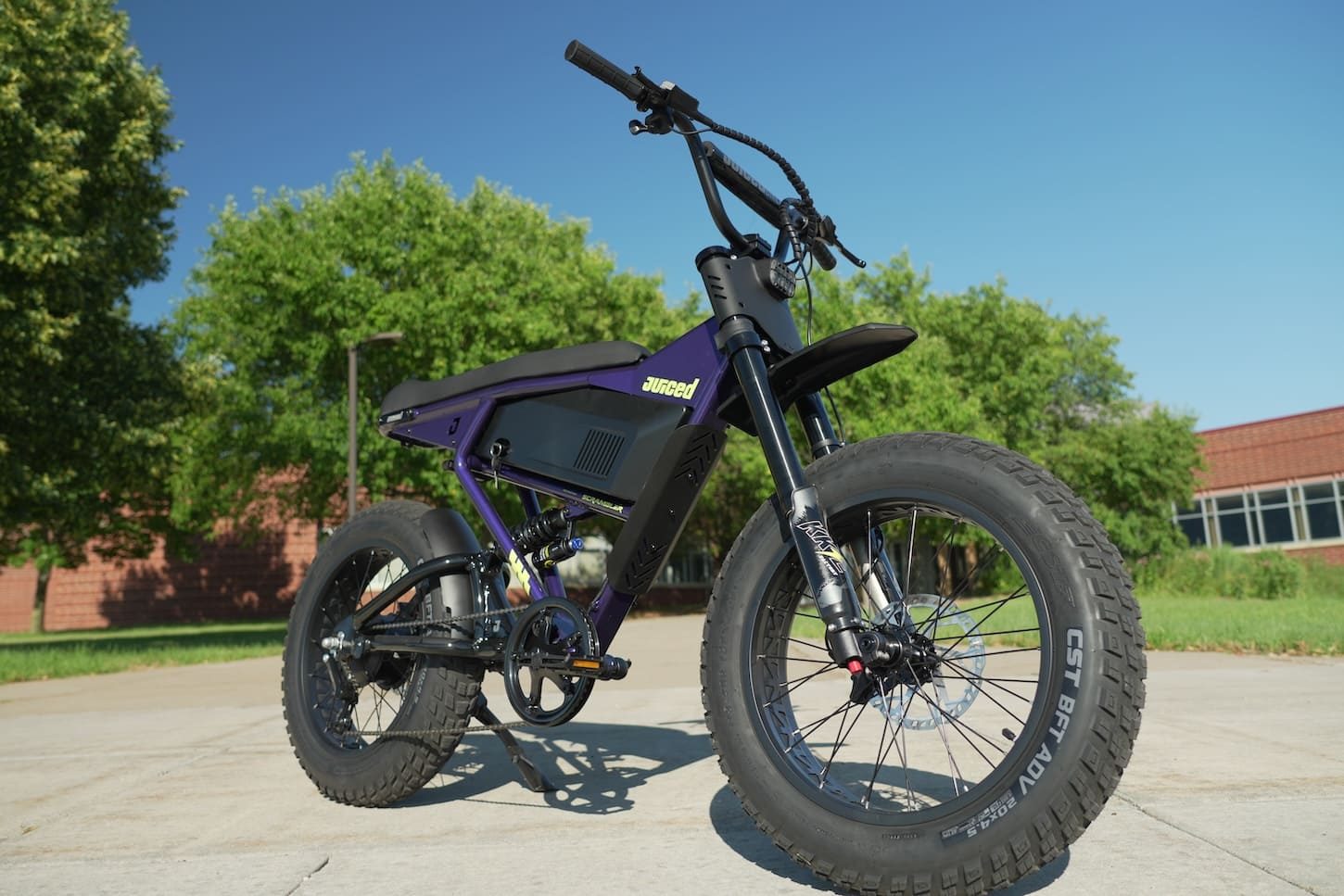
- Hero image: juiced-scrambler-e-bike-1.jpg, published within Micah Toll’s Electrek review of the Juiced Scrambler. The downloaded original is a 1450x967 JPEG. It is source editorial photography from that review, not AI-generated art and not a photo of a bike RoostMode has seen or ridden. The review does not name a separate staff photographer for the image, so no individual photo credit is claimed here beyond Electrek and Micah Toll. Modifications by RoostMode: center-cropped to a 16:9 aspect ratio and optimized for web delivery as WebP.
Read next
Moped E-Bike Showdown: Super73 vs Ariel Rider vs Ride1Up
What the established moto-style brands publish, and a fair standard to hold any new entrant to.
E-Bike Classes 1, 2, and 3 Explained
What each class legally means for throttle use, speed, and path access before you order.
The Fake UL Certification Injunction
Why a general certification claim is worth less than a named standard and a listing number.