The single most consequential thing about the second-generation Mondraker Dusty is not the redesigned frame. It is that the motor moved. Per BikeRumor’s July 30, 2026 report, the original 2023 Dusty used a hub drive, and the new one runs the TQ-HPR60 mid-drive. Moving the motor from the rear wheel to the cranks changes where assist enters the drivetrain, which is the part of this launch worth reading closely.
Everything in this article comes from that BikeRumor report, written by Jeremy Benson, which states that its photos are credited to Mondraker. RoostMode has not ridden the new Dusty, and nothing below describes how it feels on dirt. What follows is a read of the confirmed numbers, the manufacturer claims wrapped around them, and what the coverage does and does not let you decide about the four builds.
That distinction matters here more than usual, because Mondraker is pitching this bike as a category escape. The brand calls it “all-round” and says the platform “transcends the gravel category entirely,” covering gravel, weekend trips, back to back adventures, and city riding. That is positioning, not a spec. The specs are more useful.
What the TQ-HPR60 Changes About This Bike
BikeRumor calls the HPR60 a mid-power unit, and the published figures are up to 60 Nm of torque and 350 W of peak power. The report describes the Harmonic Pin Ring design as compact and very quiet, with smooth power delivery, impressive efficiency, and no drag. Those are qualitative descriptions from the report rather than measurements, and the coverage does not benchmark the HPR60 against any other drive unit, so there is no published comparison to hang a decision on.
The practical difference from the old hub-drive Dusty is where the power enters the drivetrain. A mid-drive turns the chainring, so it works through the cassette and can use your gears on a steep pitch. A hub motor pushes the wheel directly and cannot. Mondraker did not publish its reasoning for the change, so treat that as the general mechanical difference rather than a stated rationale. Separately, the spec list gives the new bike a mullet-style 1x12 drivetrain with a 42t chainring. If the tradeoff is new to you, our breakdown of mid-drive versus hub motor covers what each does to feel, wear, and service cost.
Assist is managed through three modes, customizable in the TQ app, with a color display integrated into the top tube that also handles power and mode changes. Drop bar builds get TQ’s Single Button Road Remotes, hidden under the bar tape. The RR goes further and uses the bonus buttons on the SRAM Force HRD shifters over ANT+, which is the kind of detail that only shows up on the top build.
The Frame, and What Mondraker Says About It
The claimed frame weight is 1,710 grams in size M/L, with the fork adding 490 grams, for a 2,200 gram frameset. Mondraker also says the frame meets the same ISO testing standards as its mountain bike frames. Both of those come from Mondraker, relayed by BikeRumor, and neither has been independently weighed or verified in the coverage. A frameset weight is also not a bike weight. Nobody has published what a complete Dusty weighs in any build.
The details that are hard numbers are the useful ones. Clearance runs to 50mm tires (700x50c), the geometry is compatible with gravel suspension forks, and the bike uses a UDH hanger, 12x100mm front and 12x142mm rear axles, a flat mount rear brake, and a tapered head tube. Cable routing goes through the headset via Mondraker’s Hidden Housing Guide system, which the report presents as an aesthetics decision. The coverage says nothing about what that routing means at service time, so ask a shop what a headset bearing replacement involves on this frame before you buy.
Two equipment notes deserve attention from anyone planning to commute on this. There is a KSA40 kickstand mount, which is genuinely useful. But the fender compatibility is exclusive to Mondraker’s own dedicated fenders, sold separately. On a bike sold partly on urban duty, being locked to one fender supplier is a real constraint, and no price for those fenders was published.
One inconsistency is worth flagging. The report’s body text says the Dusty comes in five frame sizes, S to XXL, while the spec highlight list gives five sizes as S, M, M/L, L, and XL. Those are not the same range at the top end. If you would be shopping the largest size, treat that as a dealer question rather than something the coverage settles.
Choosing Between RR, R, S 580, and S 360
Here is the honest situation: the launch coverage confirms four builds and four prices, but the article text available to us did not provide enough component detail to compare value between them. The Dusty RR is €8,999 and is the only build whose components the text names, through the reference to its SRAM Force HRD shift system. The Dusty R is €6,999, the Dusty S 580 is €5,999, and the Dusty S 360 is €5,499. The S is the build offered in both flat bar and drop bar, and both bar options can be had with either battery. Prices may vary by region. The launch page presents each build visually, so the parts lists may be legible there even though the text does not spell them out.
So the meaningful decision you can actually make from today’s information is the battery one, and it is a good one. The 580 Wh pack is standard on most models. On the S, you pick: 580 Wh for range, or 360 Wh for weight. That €500 difference between the S 580 and S 360 buys 220 Wh, and it also adds mass in the downtube.
The 360 Wh choice makes sense if your rides are short enough that you finish with charge left over, and if you care about carrying less. Capacity you never use is capacity you still have to pedal. The 580 Wh choice makes sense if you are doing the back to back adventure riding Mondraker is describing, or if you simply do not want to think about it. Every build takes the 160 Wh range extender, which mounts in a bottle cage position on a Fidlock mount. That does not erase the gap. With the extender fitted, a 580 Wh bike carries 740 Wh and a 360 Wh bike carries 520 Wh, so the 220 Wh difference follows you up to the top of each bike’s capacity.
What to Settle Before You Order
BikeRumor says the bikes are available now and points readers to Mondraker’s site for full specs, regional availability, and dealers. That is where the coverage ends and your questions start.
- The full parts list for each build. The launch text we have does not enumerate components, so a €2,000 gap between the R and the RR is not a gap you can evaluate from it.
- Complete bike weight, per build and battery. The frameset claim tells you nothing about the bike you lift onto a rack.
- Whether your market gets it, and at what price. The euro figures are the only prices published, and no conversion is a real price.
- Flat bar or drop bar, if you are looking at the S. That choice is only offered on that build, and it changes the bike more than the paint does.
- What the dedicated fenders and range extender cost. Neither figure was announced, and both are likely purchases.
A dealer can close most of that in one conversation. Our dealer directory is a place to start looking for a shop that can put you on a size before the geometry chart matters.
Sources
- 2nd Gen Mondraker Dusty e-Gravel Bikes Include TQ Mid-Drive Motors and a Redesigned Frame (BikeRumor, Jeremy Benson, July 30, 2026), the source for every factual claim in this article: the 2023 original Dusty and its hub drive; the switch to the TQ-HPR60 mid-drive at up to 60 Nm, 350 W peak power, three app-customizable assist levels, and a claimed 200% assistance; the 580 Wh and 360 Wh internal battery options and 160 Wh Fidlock range extender compatibility; the top tube TQ color display, Single Button Road Remotes on drop bar builds, and the RR’s SRAM Force HRD bonus button integration over ANT+; the Stealth Air Carbon frame, claimed 1,710 g frame weight in M/L plus 490 g fork for a 2,200 g frameset, the ISO testing statement, and the quoted Mondraker descriptions; 700x50c clearance, suspension fork compatibility, Hidden Housing Guide headset routing, UDH hanger, 12x100mm and 12x142mm axles, flat mount rear brake, tapered head tube, KSA40 kickstand mount, Mondraker-only fender compatibility sold separately, and the mullet-style 1x12 drivetrain with 42t chainring; the five frame sizes and the discrepancy between the body text and the spec list; the four builds at €8,999, €6,999, €5,999, and €5,499 with the note that prices vary by region; the flat bar and drop bar options on the S; and the statement that the bikes are available now.
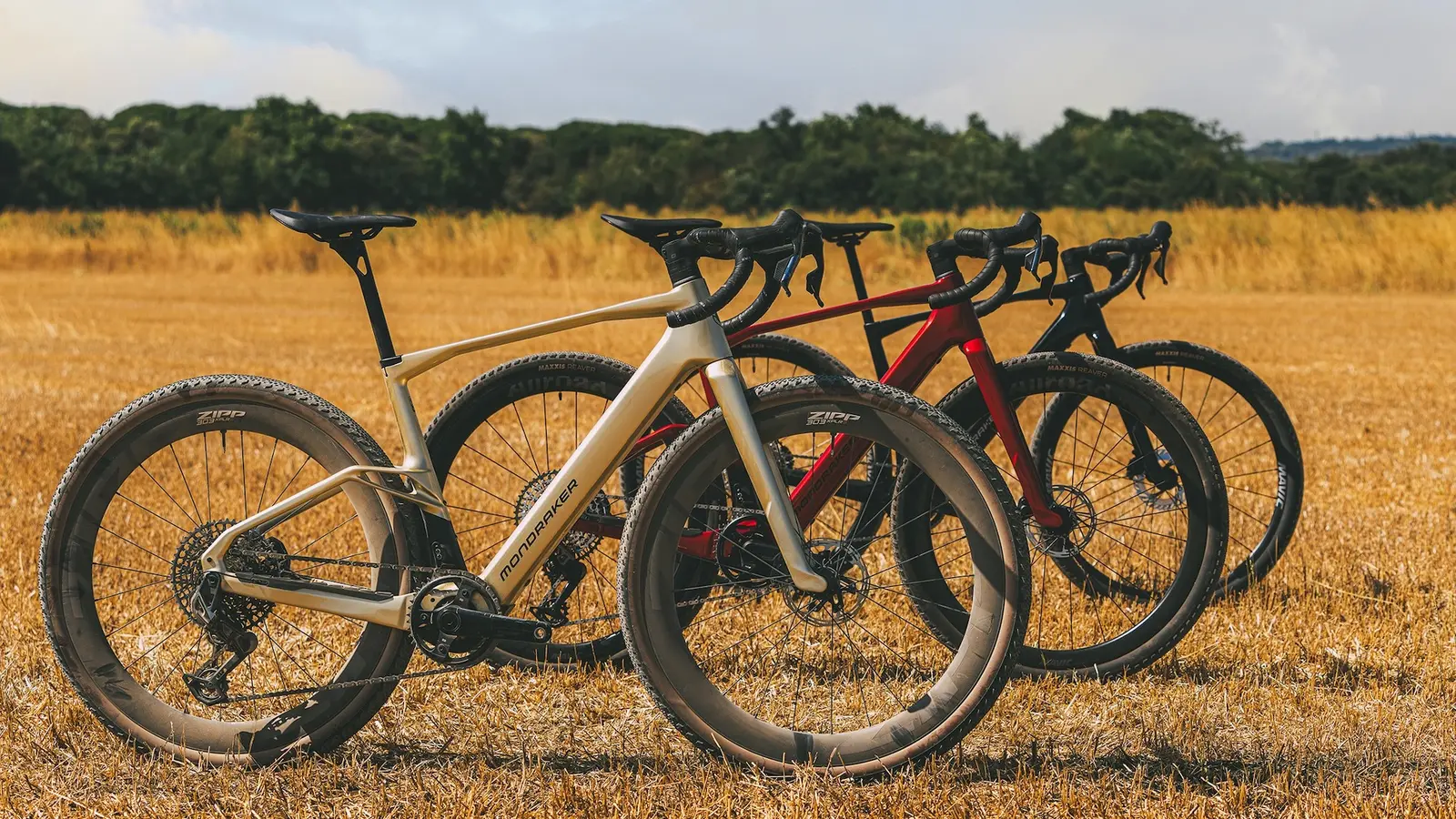
- Hero image: Mondraker-Dusty-lineup.jpeg, published by BikeRumor with the July 30, 2026 report and credited in that report to Mondraker. The image shows three Dusty e-gravel bikes lined up in a field and is manufacturer-supplied launch photography, not an image of a bike RoostMode has seen or ridden. Modifications by RoostMode: center-cropped to a 16:9 aspect ratio and optimized for web delivery as WebP.
Read next
Mid-Drive vs Hub Motor
Why moving the motor to the cranks changes climbing, wear, and service cost.
The Weight vs Range Tradeoff, Priced Out
What a lighter e-bike actually costs you in capacity, using another 2026 launch as the example.
How Long Does an E-Bike Battery Last?
Cycle life, capacity fade, and what 360 Wh versus 580 Wh looks like after a few seasons.