
On July 31, 2026, New York Attorney General Letitia James issued a consumer alert with a message aimed at both sides of the counter: marketing and selling a vehicle as an e-bike or e-scooter when it exceeds New York’s speed or power limits violates New York law. The Office of the Attorney General (OAG) says machines that clear those limits may instead be e-motos, mopeds, or motorcycles, which carry registration, licensing, and insurance requirements that no e-bike does.
For buyers, that reframes the problem. The risk is not only that a fast machine might get you a ticket. It is that the category printed on the product page may not be the category the state puts the machine in, and the gap between those two things lands on the person who paid.
The Numbers New York Actually Uses
The OAG alert restates the state’s limits plainly. A New York e-bike must have a motor of less than 750 watts. Assistance has to cut off at a defined speed, and which speed applies depends on the class and on where you are riding.
New York e-bike classes as described by the OAG alert
data| Class | How assist is delivered | Assisted speed limit | Where it is legal in New York | Helmet requirement per OAG |
|---|---|---|---|---|
| Class 1 | Pedal assist only, no throttle | Assistance under 20 mph | Statewide | Not specified in the alert for Class 1; local rules may require one |
| Class 2 | Throttle allowed | Assistance up to 20 mph | Statewide | Not specified in the alert for Class 2; local rules may require one |
| Class 3 | Speed throttle-assisted | Assistance stops at 25 mph | New York City only; Class 3 is illegal outside NYC | Required for riders of any age |
Two other statewide rules come with those classes. The minimum operator age is 16. And every e-bike sold in New York needs a permanent label stating the class, the top assisted speed, and the motor wattage.
The OAG also draws the outer boundary in a single sentence worth memorizing: electric-assisted bicycles faster than 25 mph in New York City, or faster than 20 mph outside New York City, are not e-bikes under New York law. A machine on the wrong side of that line does not become an e-bike because the seller calls it one.
New York’s Class 3 Is Not the Class 3 You Have Read About
This is the single most common place a New York buyer gets tripped up by out-of-state information. In many states, Class 3 means pedal assist that cuts off at 28 mph. New York does not use that definition. The OAG describes Class 3 in New York as speed throttle-assisted with assistance stopping at 25 mph, and Class 3 is illegal outside New York City.
Both halves of that matter, and they fail in different directions:
- If you live in New York City, a bike sold to you as a 28 mph Class 3 is above the 25 mph figure the OAG cites for Class 3 here.
- If you live anywhere else in the state, the class itself is the problem. Per the OAG, Class 3 is illegal outside NYC regardless of how the bike is labeled, which leaves 20 mph as the practical assisted-speed ceiling for a legal e-bike in most of New York.
A national brand with one product page for all fifty states has no way to sort that out for you. Our guide to e-bike classes 1, 2, and 3 covers how the class system is normally written, which is exactly why the New York variation deserves a separate read.
Read the Permanent Label Before You Pay
The label requirement is the most useful consumer protection in the alert, because it turns a marketing question into a physical one. Per the OAG, an e-bike sold in New York must carry a permanent label with three things: class, top assisted speed, and motor wattage.
That gives you a checkable object. Before money changes hands, find the label on the bike itself and compare all three fields against the listing, the box, and the spec sheet. If the label is missing, if it is a sticker that peels, or if any of the three numbers disagree with what you were told, you have a concrete question for the seller rather than a vague worry.
The Pre-Purchase Checklist
What to verify before paying, and why it matters
data| Check | What to ask or look for | Why it matters |
|---|---|---|
| Permanent label | Class, top assisted speed, and motor wattage, physically on the bike | The OAG says e-bikes sold in New York must carry this label; a missing or peel-off label is a red flag |
| Rated power | The rated motor wattage, in writing, not the peak or burst figure | New York e-bikes must have a motor of less than 750 watts per the OAG |
| Assisted speed cutoff | The speed at which assistance stops, for the build you are buying | Over 25 mph in NYC, or over 20 mph elsewhere in the state, and the OAG says it is not an e-bike |
| Class, for your location | Which class the bike is, and whether that class is legal where you ride | The OAG states Class 3 is illegal outside New York City |
| Modification or unlock claims | Whether any setting, app, or dongle raises the speed or power past the label | The OAG says businesses may not sell machines intended to be modified past legal limits |
| Vehicle category | Whether the seller classes it as an e-bike, e-moto, moped, or motorcycle | The OAG says machines over the limits may require registration, licensing, and insurance |
| Return policy | The return window, restocking fee, and who pays freight if the class is wrong | A misclassified machine is only fixable if you can still send it back |
| Service and parts | Who services it in New York, and whether parts ship to you | Category disputes can affect where a shop is willing to work on the machine |
| Local rules | Your city, town, or village rules on top of state law | The OAG notes local rules may be stricter than the statewide baseline |
The Unlock Question Is Now a Seller Question
The alert is explicit that businesses may not advertise or sell machines as e-bikes unless they fit a class, and may not sell machines intended to be modified past legal limits. That second clause is the one to raise directly with a salesperson.
If a seller volunteers that a bike ships in a restricted mode and there is a setting to remove the cap, treat that as material information about what you are being sold, not as a bonus feature. Ask them to state in writing what the bike does as delivered, at the label’s numbers. A verbal aside about a hidden menu is not something you can point to later.
Returns and Service Are the Part People Forget
A classification problem is only cheap to fix while the return window is open. Before you pay, find out how long that window is, what the restocking fee is, and who pays return freight on a bike that weighs what an e-bike weighs. Those three answers decide whether “the label does not match the listing” is an inconvenience or an expensive lesson. Direct-to-consumer sales are where this bites hardest, because there is no local counter to carry the machine back to.
Service is the quieter version of the same issue. Ask which shops in New York will actually work on the machine, and whether replacement parts ship to individual owners. A shop’s willingness to take on a repair can depend on what category the machine falls into, and a bike nobody nearby will service is a bike you stop riding well before any legal question is settled.
If It Is Not an E-Bike, It Is Something Else
The OAG’s framing is that these machines do not fall into a gap. If a vehicle exceeds the limits, it may instead be an e-moto, moped, or motorcycle, with registration, licensing, and insurance requirements attached.
That is a different ownership cost and a different set of obligations from the one most people picture when they buy an electric bike, and it is worth pricing before purchase rather than discovering at a traffic stop. The New York DMV publishes its own guidance on electric scooters, bicycles, and other unregistered vehicles, and it is the right place to confirm what a specific machine requires. Our explainer on the e-moto classification problem covers why pedals alone do not settle the question, and the Aniioki A9 buyer check walks through a machine sold as an e-bike whose published figures sit well outside any class.
Helmets, Age, and Local Rules
Per the OAG: riders of any age need helmets on Class 3, and riders age 16 and 17 need helmets on e-scooters. The minimum operator age is 16 statewide. The alert also notes local rules may be stricter, which is not a footnote in New York. Municipalities have been writing their own e-bike rules, as Riverhead’s ordinance shows, and a bike that is legal statewide can still run into a local restriction on where and how you ride it. For the wider picture outside New York, see our state-by-state e-bike law roundup.
Why OAG Issued This Now, and What It Did Not Say
The OAG framed the alert in the context of recent deadly crashes. The release does not identify those crashes or provide data about them, so we are not going to characterize them further. What the alert does provide is a compliance message to businesses and a complaint channel for consumers.
If you believe a seller misrepresented a machine’s class, power, or speed, the OAG says consumers can file a complaint online or call 1-800-771-7755.
FAQ
+Can I buy a 28 mph Class 3 e-bike in New York?
+What is the wattage limit for a New York e-bike?
+What has to be on the label?
+Who needs a helmet?
+What if the machine turns out not to be an e-bike?
Read next
E-Bike Classes 1, 2, and 3 Explained
The standard class definitions, and why New York's Class 3 does not match them.
The E-Moto Problem: When an Electric Bike Is Not an E-Bike
Why adding pedals to a high power machine does not settle its legal category.
E-Bike Laws by State (2026)
How other states define the classes, useful when a listing was written for a national audience.
Riverhead's E-Bike Ordinance
A New York example of local rules layered on top of the state baseline.
Sources
- Attorney General James Reminds New York Consumers and Businesses About E-Bike and E-Scooter Laws (New York State Office of the Attorney General, July 31, 2026), our source for every legal figure and requirement in this article: that marketing or selling vehicles as e-bikes or e-scooters above New York’s speed or power limits violates state law; that such vehicles may instead be e-motos, mopeds, or motorcycles with registration, licensing, and insurance requirements; the under 750 watt motor limit; the Class 1, Class 2, and Class 3 definitions including New York’s 25 mph Class 3 threshold and the fact that Class 3 is illegal outside New York City; the permanent label requirement covering class, top assisted speed, and motor wattage; the statewide minimum operator age of 16; the statement that electric-assisted bicycles faster than 25 mph in NYC or 20 mph outside NYC are not e-bikes under New York law; the prohibitions on advertising machines as e-bikes when they do not fit a class and on selling machines intended to be modified past legal limits; the helmet requirements for Class 3 riders of any age and for e-scooter riders age 16 and 17; the note that local rules may be stricter; the framing of the alert following recent deadly crashes, which the release does not identify or quantify; and the complaint phone number 1-800-771-7755.
- Electric scooters, bicycles, and other unregistered vehicles (New York State DMV), cited as the official state reference readers should check for how registration, licensing, and insurance apply to a specific machine. We have not restated any figure from this page in the article.
- File a complaint (New York State Office of the Attorney General), cited as the online complaint channel the alert points consumers toward.
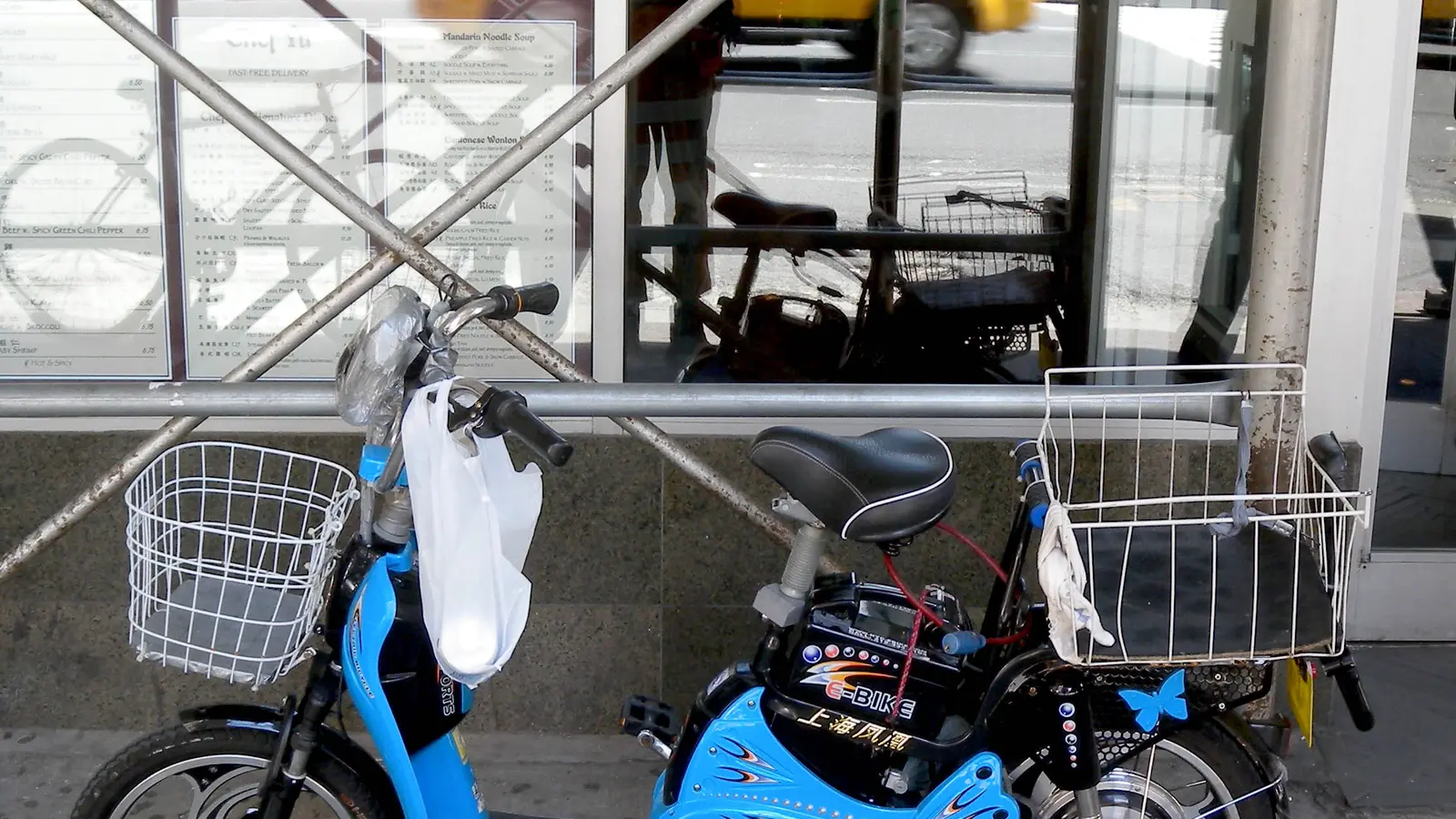
- Hero image: “E-bike 34th St jeh.jpg” by Jim Henderson, via Wikimedia Commons, public domain. It shows an electric bicycle chained on West 34th Street in Manhattan. RoostMode modifications: cropped and optimized to 1600x900. This is a real photograph used as a neutral editorial image of an e-bike in New York City. It is not connected to the OAG alert, and nothing about the pictured bike’s class, power, speed, or legal status is known or implied here.

RoostMode has not tested, inspected, or measured any machine referenced in this article, and we make no legal determination about any specific product or seller.