
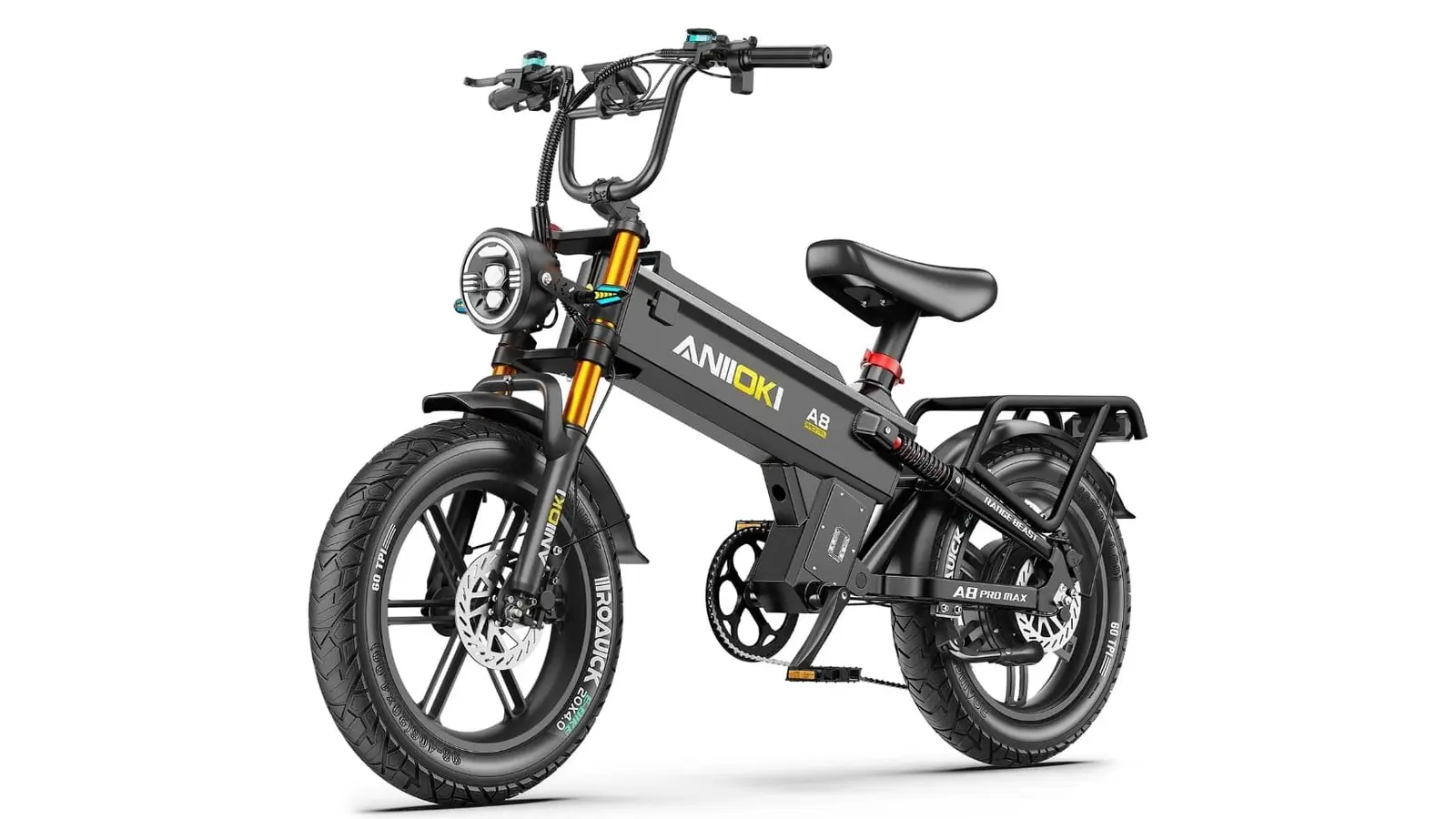
The pedals are the whole problem. Aniioki’s A9 Pro Max Dual Motor 2.0 has a bicycle saddle, a chain, a set of cranks, and a listing price that reads like a nice fat tire e-bike. It also has, per Aniioki’s own product page, two 2,500W motors rated to 3,000W peak each and a speed figure the company writes as 28 plus mph followed by a parenthetical of 40 to 45 mph.
Electrek’s Micah Toll published a piece on August 3, 2026 arguing that a machine at 6,000W peak with a battery topping out near 5 kWh has passed out of e-bike territory and into electric motorcycle numbers. He is right about the physics and right about the law, and his framing is worth reading. But the piece is a news writeup of a product announcement, not a buyer’s document, and the questions that actually decide whether you should put $2,899 down are the ones that come after the classification argument.
We went and read Aniioki’s listing alongside the Electrek report. Some of the numbers do not match, one of them matters a lot, and there is a certification line missing from the product page that ought to change how you think about where this thing charges.
What Aniioki is selling, and at what price
Electrek reports a single price of $2,899 and describes three configurations: a 60V 2.0 with dual 2,500W motors and a claimed 40 to 45 mph, a 60V 3.0 with dual 3,000W motors and a claimed 51 to 55 mph, and a flagship 72V version, also dual 3,000W, claimed at 54 to 60 mph.
Aniioki’s product page for the 2.0 that we checked shows $2,899 as a sale price against a listed regular price of $3,099 for the 60V 70Ah build, with the 80Ah build at $3,299. The page carries a “SAVE $1000” banner, which does not reconcile with the $200 gap between the sale and regular prices shown on the same page, and a stock counter reading that only 51 units are left. Treat both as merchandising, not as data.
The thing to hold onto is that the $2,899 figure attaches to the slowest of the three configurations. The 51 to 60 mph numbers in the Electrek writeup belong to the 3.0 and 72V builds, which Aniioki lists separately at prices we did not confirm. If you read the headline speed and then buy the headline price, you are not buying the same machine.
Aniioki A9 Pro Max 2.0: every figure with its source, checked August 3, 2026
data| Item | What is claimed | Source |
|---|---|---|
| Price (60V 70Ah) | $2,899 sale, $3,099 listed regular | Aniioki product page; Electrek cites $2,899 |
| Price (60V 80Ah) | $3,299 | Aniioki product page |
| Motors | Dual 2,500W, listed at 3,000W peak each, direct drive brushless | Aniioki product page |
| Combined peak | 6,000W peak combined | Electrek |
| Torque | 2 x 125 Nm maximum | Aniioki product page |
| Top speed | Listed as 28 plus mph with a parenthetical of 40 to 45 mph; page header says 45 mph max | Aniioki product page |
| Battery options | 60V 70Ah (4,200 Wh) or 60V 80Ah (4,800 Wh) | Aniioki and Electrek agree |
| Claimed range, 70Ah | 100 to 230 miles with pedal assist, 70 to 80 miles without | Aniioki product page |
| Claimed range, 80Ah | 105 to 235 miles with pedal assist, 80 to 90 miles without | Aniioki product page |
| Claimed range, as reported | Up to 200 miles (320 km) of pedal assist range under ideal conditions | Electrek, citing Aniioki |
| Brakes | CBS combined braking, 300 mm rotors, 8 piston front and 6 piston rear calipers | Aniioki product page for the 2.0 |
| Tires | 26 x 4.8 inch fat tires with puncture protection | Aniioki and Electrek agree |
| Weight | 188.3 lb (70Ah) or 192.9 lb (80Ah) | Aniioki product page |
| Load capacity | 500 lb maximum load | Aniioki product page |
| Rider support | Frame claimed twice as strong as conventional bicycle frames, supporting riders up to 400 lb (180 kg) | Electrek, citing Aniioki |
| Rider height | 5 ft 11 in to 6 ft 4 in (180 cm to 195 cm) | Aniioki product page |
| Battery construction | 4 mm aluminum enclosure, semi solid blade cells, BMS protections | Electrek, citing Aniioki |
| Charger | 67.2V 8A, 8 to 10 hour charge time | Aniioki product page |
| Warranty and returns | 1 year warranty, lifetime technical support; return window given as 15 days in the site navigation and 30 days in the page FAQ | Aniioki product page |
| UL 2849 or UL 2271 listing | Not stated anywhere on the product page we checked | RoostMode check of the Aniioki page |
| Class 1, 2, or 3 designation | Not stated anywhere on the product page we checked | RoostMode check of the Aniioki page |
Why this is not a Class 1, 2, or 3 electric bicycle
The three class system used across most of the United States describes an electric bicycle as a bike with operable pedals and a motor of 750W or less, with assistance cutting out at 20 mph for Class 1 and Class 2 and 28 mph for Class 3. Electrek’s argument is that the A9 Pro Max clears those ceilings by a wide margin and so is more appropriately categorized as an electric moped or lightweight electric motorcycle. That reading matches how the class definitions are written.
Aniioki’s own listing does not claim otherwise. We looked for a class designation, a street legal statement, an off road only disclaimer, and any reference to registration, licensing, or DOT equipment. None of those appear on the product page we checked. The page simply lists the speed and the wattage and leaves the category question to the buyer.
That silence is the practical hazard, and it is not unique to Aniioki. The listing writes the top speed as 28 plus mph before the parenthetical, and 28 mph is exactly the Class 3 ceiling. A shopper skimming for a number that looks legal will find one sitting right next to a number that is not.
Where Electrek’s writeup and Aniioki’s own listing do not match
Reading the two side by side turned up four gaps. None of them suggests bad faith on anyone’s part, and manufacturer pages get updated, but each one is a question to put to Aniioki before you order.
Load capacity. Electrek reports a frame claimed to support riders up to 400 lb (180 kg). Aniioki’s product page states a maximum load of 500 lb. Those may be measuring different things, since a rider limit and a total load limit are not the same specification, but the page does not distinguish them. If you are anywhere near either number, get the answer in writing.
Range. Electrek reports Aniioki claiming up to 200 miles of pedal assist range under ideal conditions. Aniioki’s page claims 100 to 230 miles with pedal assist on the 70Ah pack and 105 to 235 miles on the 80Ah. The listing’s top figure is higher than the number that reached print.
Brakes. Electrek attributes the eight piston front and six piston rear calipers to the flagship 72V build as an upgrade over the rest of the line. The 2.0 product page we checked lists eight piston front and six piston rear for this model. If the caliper spec is part of why you are buying, confirm it against the exact variant in your cart.
Weight. Electrek does not give one. Aniioki lists 188.3 lb for the 70Ah build and 192.9 lb for the 80Ah. That is the single most useful number on the page and it is the one least likely to appear in any writeup, because it decides whether you can pick this thing up, get it into a van, carry it up a step, or hold it at a stop with one foot down.
The battery question, and why 4.8 kWh changes the storage conversation
A common commuter e-bike carries 600 to 800 Wh. The A9 Pro Max carries 4,200 or 4,800 Wh, which is roughly six times that, and Electrek’s point that this exceeds the pack in many electric scooters and mini motorcycles is accurate.
Aniioki’s published safety story, as relayed by Electrek, is a 4 mm thick aluminum battery enclosure, semi solid blade battery cells, and battery management system protections. Those are reasonable things for a company to build. They are also marketing descriptions rather than test results. “Semi solid blade cells” has no standardized definition that a buyer can check, and an enclosure thickness is not a fire safety credential.
What we could not find on the product page is any reference to UL 2849 for the electrical system, UL 2271 for the battery, EN 15194, or any equivalent third party listing. That absence is the thing to chase. Certification is increasingly the hinge that decides whether you are allowed to charge a pack indoors at all: landlords, insurers, universities, and a growing number of municipalities write their storage and charging rules around a listing mark rather than around wattage. Our coverage of the CPSC’s proposed federal battery rule and of the lawsuit over false UL certification claims on marketplace listings explains why an unverified certification claim is worse than none at all.
Then there is the charging itself. The page lists a 67.2V 8A charger and an 8 to 10 hour charge time. That is an overnight cycle on a pack six times the size of a commuter battery, and for most buyers it will happen in a garage, a basement, or an apartment. Decide where that happens, and whether your building or insurer permits it, before the crate arrives.
Range: what those numbers do and do not tell you
Set aside which claimed figure is correct for a moment, because the more useful split on Aniioki’s page is between the pedal assist numbers and the ones without pedal assist. The company lists 100 to 230 miles with assist on the 70Ah pack, and 70 to 80 miles without it.
That second number is the one to plan around, and here is why. Electrek’s sharpest observation is that on a machine with this much power and a throttle, the pedals are likely to become a set of splayed footrests for most people. If that is how you will actually ride it, the pedal assist figure describes a use case that is not yours. Aniioki’s own throttle-only claim is roughly a third of its own headline.
Neither figure is a measurement. Both are manufacturer claims under conditions the page does not specify, and nobody has published an instrumented range test of this machine. Speed, terrain, rider weight, temperature, and tire pressure all move the result, and a machine claiming 40 to 45 mph will drain a pack far faster at 40 mph than at 20. If a specific range figure is load bearing for your purchase, wait for independent testing rather than picking a number off either the listing or the writeup.
A pre-purchase checklist
None of this is an argument against the machine. It is an argument for doing seven things before you pay, roughly in this order.
Call your DMV or equivalent agency first, not last. Describe the vehicle by its numbers, 6,000W peak and a claimed 40 to 45 mph with operable pedals, rather than by the words “electric bike,” and ask what category that lands in and what it requires. This is the step that determines whether everything after it matters, and the answer genuinely differs by state. Our e-bike laws by state guide is a starting point, not a substitute for that call.
Call your insurer with the same description. Ask two separate questions: whether they will write a policy on it, and whether your existing home or renters policy covers theft of it and covers charging it indoors. A vehicle that falls outside the electric bicycle definition can also fall outside the personal property coverage riders assume they have.
Confirm which variant you are buying. The price, the speed, the motor rating, and possibly the caliper spec all move between the 2.0, the 3.0, and the 72V. Match the spec sheet to the exact item in the cart.
Get the certification answer in writing. Standard, body, and listing number, verified in the issuing body’s directory.
Check the fit gate. Aniioki lists a rider height range of 5 ft 11 in to 6 ft 4 in. Riders outside that band should treat this as a real constraint rather than a suggestion, especially on a machine that weighs about 190 lb.
Read the returns terms against the shipping reality. The page states free shipping, and it states the return window twice with two different numbers: the site navigation advertises a 15 day return, while the FAQ further down the same product page says you have 30 days after receiving the package to request a return. Get the operative figure in writing, then confirm who pays return freight on a crated 190 lb vehicle, because that number can approach a meaningful fraction of the purchase price and it is the clause that decides whether the window is worth anything.
Plan for parts and service. A one year warranty with lifetime technical support is what the page offers. Ask what happens when a controller or a motor fails in year two, whether a local shop will touch a 60V dual motor system, and where replacement cells or a replacement pack come from. Direct to consumer machines in this power class have thin service networks, and our look at Ariel Rider’s 72V private property bike covers how other brands in this bracket handle the same tension.
FAQ
FAQ
+Is the Aniioki A9 Pro Max a legal e-bike?
+Will I need to register and insure it, or get a motorcycle license?
+How much does the Aniioki A9 Pro Max cost?
+What is the real range of the A9 Pro Max?
+Is the battery UL certified?
+Can I ride it in bike lanes or on multi use paths?
+How heavy is it, and does that matter?
+Should I buy one?
Sources
- Aniioki’s latest 6,000W dual-motor e-bike blurs past the line so much it’s basically an electric motorcycle (Electrek, Micah Toll, August 3, 2026), our source for the $2,899 price, the three configuration breakdown with motor wattages and claimed speeds, the 6,000W and 7,000W combined peak figures, the up to 200 mile pedal assist range claim, the 4 mm aluminum battery enclosure, semi solid blade cells and BMS description, the frame strength and 400 lb rider claim, the caliper attribution to the 72V flagship, and the classification argument that this does not qualify as a legal electric bicycle under Class 1, 2, or 3 definitions.
- Aniioki A9 Pro Max Dual Motor 2.0 official product page (Aniioki), checked August 3, 2026, our source for the sale and regular prices on the 70Ah and 80Ah builds, the dual 2,500W motor and 3,000W peak rating, the 2 x 125 Nm torque figure, the top speed string, the four range claims split between pedal assist and no pedal assist, the CBS braking system with 300 mm rotors and the eight piston front and six piston rear calipers listed for this model, the 26 x 4.8 inch tires, the 188.3 lb and 192.9 lb weights, the 500 lb maximum load, the 5 ft 11 in to 6 ft 4 in rider height range, the 67.2V 8A charger and 8 to 10 hour charge time, and the one year warranty, lifetime technical support, and the two conflicting return windows. We also checked this page for any UL, EN, class designation, street legal, registration, or DOT language and found none.
- Hero image: Aniioki official product photography, published by Electrek as the lead image for the story cited above. RoostMode modifications: cropped and optimized. One caveat we are flagging rather than hiding: the machine in this photograph is badged A8 Pro Max on both the frame and the swingarm and wears 20 x 4.0 inch tires, while both Aniioki and Electrek list the A9 Pro Max with 26 x 4.8 inch tires, and Aniioki sells the A8 Pro Max as a separate model aimed at shorter riders. The image therefore appears to show a different bike in Aniioki’s range rather than the A9 Pro Max this article is about. It is a studio product photograph supplied by the manufacturer, not a photograph of a bike in use, and it is not evidence of any performance claim in this article.
Read next
The E-Moto Problem: When an Electric Bike Is Not an E-Bike
Why bolting pedals to a high power machine does not make it an electric bicycle.
E-Bike Classes 1, 2, and 3 Explained
The wattage and speed ceilings the A9 Pro Max clears, and what the class label is for.
E-Bike Laws by State (2026)
Where to start before you call your DMV about a machine like this one.
Electric Dirt Bike Battery Guide
What cell, pack, and certification specs actually tell you about a large battery.