
On August 4, 2026, the New York City Council announced it will hold a hearing on September 30 covering e-bike and e-scooter safety, a slate of more than a dozen proposed bills, and oversight of how the city enforces the laws already on the books. Nothing has been voted into law. This is a hearing announcement, and the bills attached to it are proposals that have not passed.
That distinction matters for anyone riding, buying, selling, or dispatching e-bikes in New York City right now. Current rules on class, speed, and where you can ride have not changed because of this announcement. What has changed is that the Council has put a date and a list of named bills on the table, and riders, delivery workers, and buyers have a reason to start paying attention before any of it moves.
What Was Actually Announced
The Council says the September 30 hearing will be led by Speaker Julie Menin, along with Majority Leader Shaun Abreu (who chairs the Committee on Transportation and Infrastructure), Council Member Harvey Epstein (chair of the Committee on Consumer and Worker Protection), and Council Member Oswald Feliz (chair of the Committee on Public Safety). The Council frames it as a wide-ranging hearing that will take testimony from city agencies, transportation and public safety experts, advocates, workers, and members of the public, and will include oversight of how existing e-bike and e-scooter laws are currently being enforced, alongside the new bills.
The release ties the hearing to rising e-bike collision numbers, citing a 31.7% year-over-year increase in e-bike collisions and stating there have been over 500 e-bike collisions in 2026 so far. It also references two specific incidents: a May crash involving an illegal high-speed e-scooter on the Queensboro Bridge that killed two people, and a Central Park crash last month in which a jogger was struck by an e-bike rider going the wrong way and left in a days-long coma. The release does not provide additional data behind the collision figures, and we are not going to characterize the incidents beyond what the Council states.
The Named Bills, and What Each Would Actually Do
The Council’s release lists an initial set of bills already introduced. Each has its own sponsor and its own scope. None of them are law today.
Delivery platform licensing (Introduction 950, Council Member Lynn Schulman). Would require delivery services operating in the city to get a business license from the Department of Consumer and Worker Protection, giving the city a licensing hook for enforcement.
Class 3 sale and rental ban (Introduction 244, Council Member Crystal Hudson). Per the release, would prohibit selling or renting Class 3 e-bikes in the city, with civil penalties up to $2,000. New York City’s Class 3 is speed throttle-assisted with assistance stopping at 25 mph and legal only within the city, not the generic pedal-assist definition, with assistance up to roughly 28 mph, used in many other states. The proposal most directly relevant to anyone shopping for an e-bike in New York City, since it targets the point of sale.
Street design task force (Introduction 124, Council Member Selvena Brooks-Powers). Would create a task force to study street design and infrastructure options for pedestrians, drivers, cyclists, and e-bike riders together.
Delivery app data reporting (Introduction 78, Council Member Gale Brewer). Would require third-party delivery apps to submit driver ID, delivery time, and location data to the city.
Commercial bicycle safety law expansion (Introduction 110, Council Member Selvena Brooks-Powers). Would expand the city’s commercial bicycle safety rules to cover other delivery devices used commercially, including e-bikes, mopeds, and motorcycles, not just traditional bicycles.
NYPD enforcement transparency (Introduction 787, Council Member Selvena Brooks-Powers). Would require NYPD to publicly report where it conducted targeted traffic enforcement, why those locations were chosen, what violations were issued (including e-bike and e-scooter violations), and how enforcement affected safety compared to periods without it. The bill worth watching if you care about how evenly current laws are enforced.
Moped registration verification (Introduction 389, Council Member Lincoln Restler). Would require third-party food delivery services to verify that mopeds used by their workers are properly registered before use, on the premise that registration is required but nothing currently forces a delivery platform to check.
Leaving-the-scene penalties (Resolution 44, Council Member Gale Brewer). Calls for increased penalties for leaving the scene of a crash on an e-scooter, expanded to cover e-bikes. As a resolution, this is a statement of Council intent rather than a proposed local law.
Moped operation materials (Introduction 95, Council Member Gale Brewer). Would direct the Department of Consumer and Worker Protection, with the Department of Transportation, to develop and distribute materials on legally operating a moped.
The release also names five additional bills coming in the weeks ahead, without bill numbers yet: insurance requirements for third-party delivery apps, trade-in incentives for unsafe devices, stronger consumer protections, expanded enforcement, and infrastructure changes aimed at slowing high-speed riding.
What Riders, Buyers, and Delivery Workers Should Watch Next
None of this changes what you can legally buy, sell, ride, or ask a courier to ride tomorrow. But a few of these proposals would touch specific parts of how e-bikes work in the city if they move forward.
If you’re shopping for an e-bike in NYC, Introduction 244’s proposed Class 3 sale and rental ban is the one to track. The release describes a restriction on sale and rental; it does not say the proposal would change possession or riding rules for a Class 3 bike you already own. It would change what a shop can sell going forward. Our guide to e-bike classes 1, 2, and 3 covers today’s baseline, which this bill would change if enacted.
If you rely on delivery platforms, as a worker or a customer, Introduction 950 (platform licensing), Introduction 78 (app data reporting), and Introduction 389 (moped registration verification) target the platforms rather than individual riders. Several Council members quoted in the release frame this as intentional: holding companies accountable for routing, timing, and registration checks rather than penalizing the workers they dispatch.
If a machine you’re considering might be a moped or e-moto rather than an e-bike, Introduction 389 and Introduction 95 both treat mopeds as a distinct category, separate from e-bike rules. Our e-moto classification explainer covers why pedals alone don’t settle that question, and the New York Attorney General’s July 2026 consumer alert covers the same wattage and class distinctions from the state’s side rather than the city’s.
If you want to know how current law is actually being enforced, Introduction 787’s transparency requirement is the one to watch. It wouldn’t change what’s illegal, only how visible NYPD’s targeted enforcement becomes.
A Practical Watch List Before September 30
- Confirm today’s rules still apply. Class definitions, speed limits, and registration requirements haven’t changed because of this announcement. For the current baseline, see our state-by-state e-bike law roundup and the New York AG’s buyer checklist.
- Buying a Class 3 e-bike in NYC soon? Don’t assume the current sale rules are permanent. Introduction 244 would end Class 3 sale and rental if it passes. It hasn’t yet.
- Delivery worker or running a delivery-dependent business? Watch Introduction 950, Introduction 78, and Introduction 389, which would shift compliance obligations onto platforms rather than individual riders.
- Care about enforcement transparency? Introduction 787 is the only bill here that would make NYPD’s enforcement patterns public rather than changing what’s legal.
- Mark September 30. That’s when the Council says it will take testimony. A hearing date is not a vote date, and none of these bills has an announced timeline for passage.
Sources
- Speaker Julie Menin and Council Members to Launch Sweeping Review of E-Bike and E-Scooter Safety (New York City Council, August 4, 2026), our source for the Council-specific facts in this article: the September 30 hearing date and its leadership; the hearing’s stated scope covering testimony, legislative proposals, and oversight of existing enforcement; the cited 31.7% year-over-year rise in e-bike collisions and the over 500 collisions reported in 2026; the Queensboro Bridge and Central Park incidents as described in the release; the text and sponsors of Introduction 950, Introduction 244, Introduction 124, Introduction 78, Introduction 110, Introduction 787, Introduction 389, Resolution 44, and Introduction 95; the list of five additional bills to be introduced later; and the quotes attributed to Speaker Menin, Majority Leader Abreu, and Council Members Hudson, Brewer, Epstein, Schulman, Brooks-Powers, and Maloney.
- Attorney General James Reminds New York Consumers and Businesses About E-Bike and E-Scooter Laws (New York State Office of the Attorney General, July 31, 2026), our source for New York City’s Class 3 definition described above: that NYC’s Class 3 is speed throttle-assisted, that assistance stops at 25 mph, and that Class 3 is legal only within New York City.
- Legistar (New York City Council Legislative Research Center), the official tool for looking up the live status of any numbered introduction or resolution named in this article. We cite it as a status-lookup resource, not as a source for any bill’s current status beyond what the Council’s press release states.
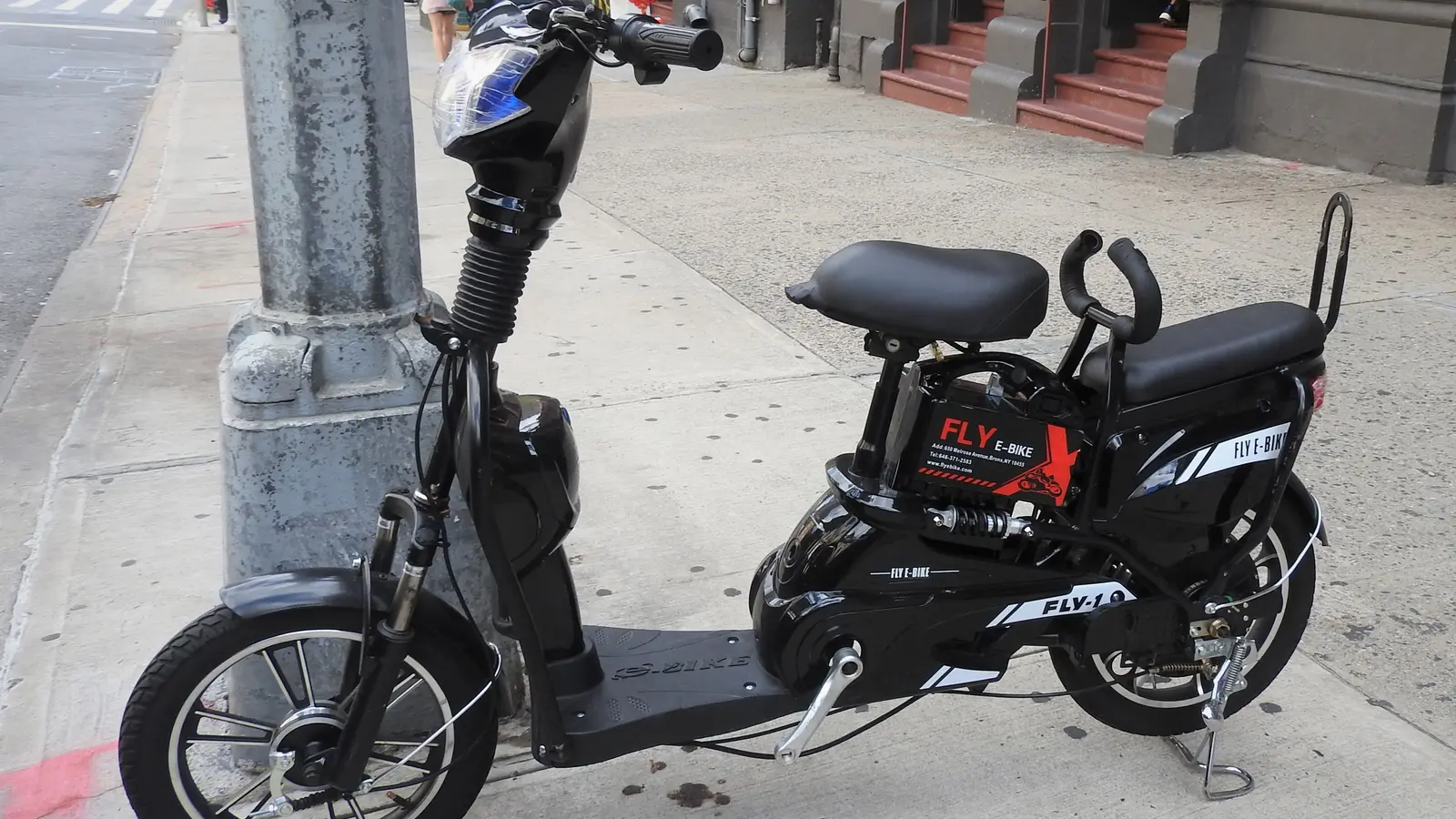
- Hero image: “Fly-1 E-bike on E96 2020 jeh.jpg” by Jim Henderson, via Wikimedia Commons, licensed CC BY 4.0. It shows a Fly-1 scooter-style electric bicycle parked on the East 96th Street sidewalk in Manhattan. RoostMode modifications: cropped and optimized. This is a contextual photograph of an e-bike in New York City and does not establish the pictured vehicle’s class or legal status, and it is not connected to the Council’s announcement.

RoostMode has not tested, inspected, or measured any machine referenced in this article, and we make no legal determination about any specific bill’s chances of passage or about any product’s legal status.
Read next
New York's AG Warns That Overpowered Machines Sold as E-Bikes Are Illegal
The state-level label and wattage checklist for New York buyers, from the Attorney General's July 2026 alert.
E-Bike Classes 1, 2, and 3 Explained
The standard class definitions used in most states, which don't match New York City's own Class 3 threshold.
The E-Moto Problem: When an Electric Bike Is Not an E-Bike
Why pedals alone don't settle whether a machine is an e-bike, an e-moto, or a moped.
E-Bike Laws by State (2026)
The current, unchanged baseline for e-bike rules outside whatever this hearing eventually produces.