
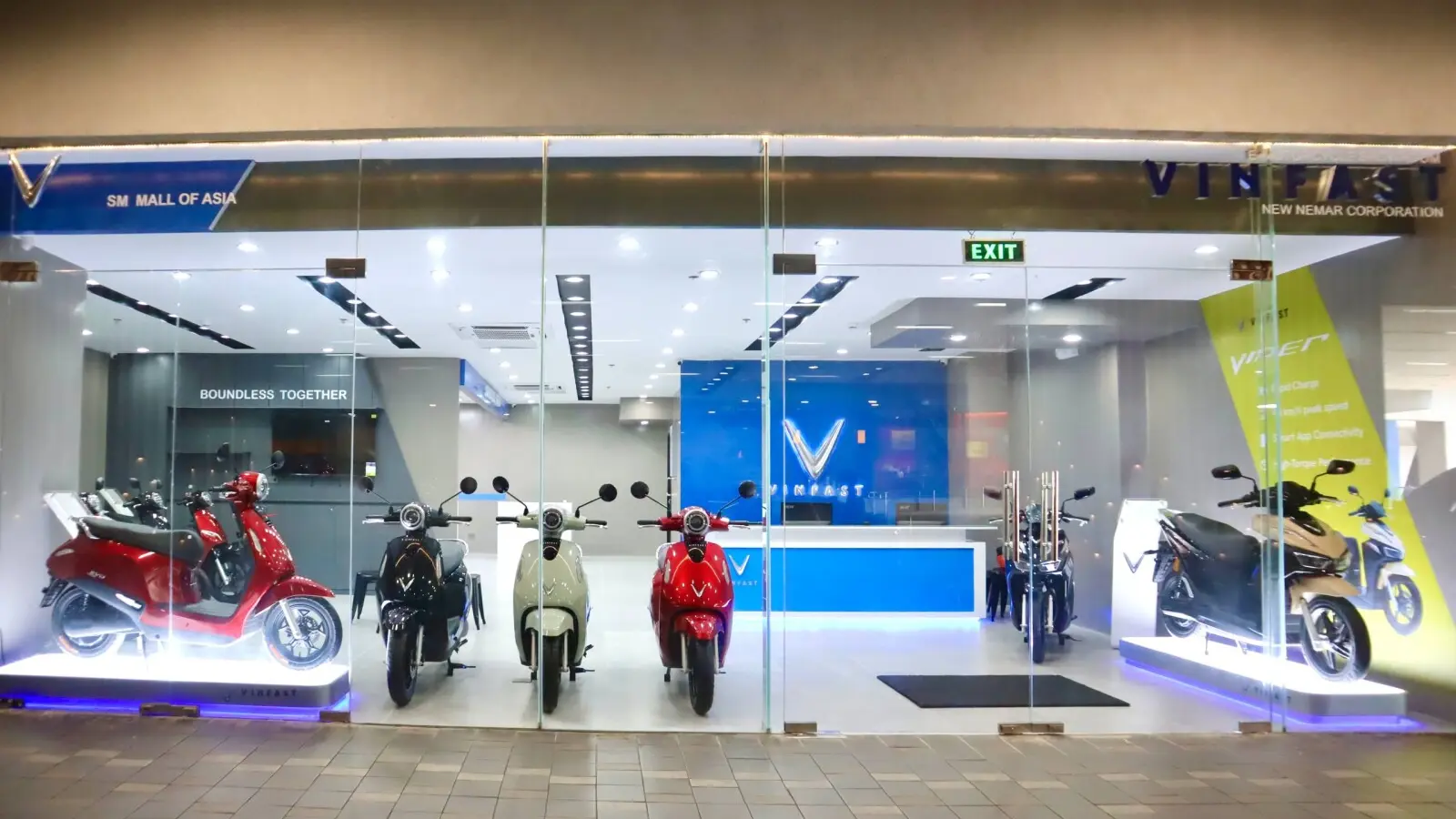
VinFast says it has opened 21 electric motorcycle showrooms across major Philippine cities, launching the Evo, Feliz II, and Viper into the market at the same time. The announcement also floats a much larger number: a plan to deploy 30,000 battery-swapping cabinets nationwide with infrastructure partners.
Those two figures deserve very different weight, and the gap between them is the whole story for anyone thinking about buying.
Opened versus planned: read the two numbers differently
The 21 showrooms are described as open. That is a checkable, present-tense claim, and retail footprint matters because it is where warranty work, parts, and disputes eventually land.
The 30,000 battery-swapping cabinets are a stated plan involving infrastructure providers. There is no figure in this announcement for how many cabinets exist today, where they are, or when they arrive. A plan of that size may well be executed, but a buyer cannot ride on a plan. If you are weighing a swap-based motorcycle against a conventional charge-at-home one, the only number that affects your commute is the count of working cabinets on your actual routes this month.
That distinction matters more than usual here, because swapping is the core pitch. The dealerships are described as all-in-one locations covering displays, energy solutions, technical service, consultations, test rides, one-minute battery-swap demonstrations, home-charging options, ownership selection, and after-sales support. A one-minute swap demo in a showroom proves the hardware works. It does not tell you what a Friday evening queue looks like at a busy public station.
These are motorcycles and scooters, not US-class e-bikes
Claimed top speeds of 80 to 90 km/h (roughly 50 to 56 mph) put all three models firmly in registered-vehicle territory. They are not comparable to the pedal-assist e-bikes that dominate US class-based rules, and readers arriving from that side of the market should reset expectations: this is a licensed, registered, insured category of machine.
We are not going to give you specific Philippine licensing thresholds, because this announcement is not a government source and we will not invent one. Confirm current Philippine registration, licensing, helmet, insurance, and road-access requirements with the appropriate authorities and with the dealer, in writing, before you buy. For the general framing of why this classification boundary keeps tripping buyers up, our piece on the e-moto versus e-bike classification problem covers the reasoning.
The three models, as claimed
Every figure in this table comes from VinFast. Manufacturer maximum range is a best-case laboratory-style figure, not real-world range, and real riding with wind, load, traffic, and heat will come in lower.
VinFast Philippines lineup (manufacturer claims)
data| Model | Claimed top speed | Claimed max power | Claimed range | Battery bays | Swap compatible |
|---|---|---|---|---|---|
| Evo | 80 km/h | Not stated in the release | Up to 150 km with two fully charged batteries (manufacturer claim, not real-world) | Two under-seat compartments | Yes, per VinFast |
| Feliz II | 90 km/h | Not stated in the release | Not stated in the release | Two under-seat compartments | Yes, per VinFast |
| Viper | 90 km/h | 5,200W | Not stated in the release | Two under-seat compartments | Yes, per VinFast |
Note what is absent. The release does not give battery capacity, pricing, curb weight, charge times, or payload for any of the three. Anyone quoting those numbers to you is quoting something other than this announcement, so ask where they got them.
The money question nobody can answer for you yet
VinFast says buyers can either purchase with batteries included or take a battery subscription, depending on their needs. Owners are also said to get free battery swaps at V-Green public stations for one year, capped at 20 swaps per month per vehicle.
That promotional year is doing a lot of work in the pitch, and it is exactly where the analysis has to slow down.
The comparison you need is not “which option is cheaper today.” It is the total cost over the years you expect to own the machine. Buying with batteries means a higher figure up front, and you carry the risk of pack degradation and eventual replacement yourself. A subscription lowers the entry price and shifts pack risk to VinFast, but it is a recurring bill that continues for as long as you own the bike, and it can be repriced.
The free-swap year does not change that arithmetic so much as postpone it. What determines whether the subscription route works out is the price in year two and beyond, and what a swap costs once the promotion lapses. Neither figure is in this announcement. We are not going to model example costs, because doing so would mean inventing prices that nobody has published.
Also worth pinning down: the 20-swaps-per-month cap. For most commuters that is generous. For a rider doing high daily distance, or for delivery work, it is a real ceiling worth checking against your own weekly pattern before you assume free means unlimited.
Warranty: get the split explained
The release describes coverage as “4+2-year or 60,000+12,000-km, whichever comes first.” The accessible text does not clearly explain what the two halves of each pair cover, and we are not going to guess at it, because the difference between the vehicle and the battery pack being on different terms is the kind of thing that matters years later.
Ask the dealer to write out, on paper: what the first number covers, what the second number covers, whether the pack is covered differently under purchase versus subscription, and what the degradation threshold is for a pack replacement claim.
Pre-purchase checklist
Work through this before any deposit. It is written to be usable at the counter.
- Get the actual swap map. Not the planned network, not the 30,000 figure: a current list of live cabinet locations. Check it against your commute, your workplace, and the routes you ride at night.
- Ask about station hours and uptime. A cabinet that is inside a mall that closes at 9pm is not available for a late shift. Ask what the published uptime is and who to call when a station is down.
- Ask about queue behavior. What happens at peak? Is there an app that shows how many charged packs a given cabinet is holding right now?
- Confirm pack availability. A swap station is only useful if it has a charged pack in it for your model. Ask how stock is managed at busy sites.
- Nail down the post-promotional subscription price and per-swap cost after the free year, plus the terms under which VinFast can change them.
- Confirm the home-charging fallback. If the network near you is thin, home charging is your primary plan, not your backup. Ask what the home charging setup involves and how long a full charge takes.
- Get the warranty split in writing, including separate vehicle and battery terms.
- Ask about service parts. Which of the 21 locations does actual technical work, what is the typical wait for parts, and where does your machine go if the nearest showroom cannot fix it?
- Clarify the exit terms. If you take a subscription, what happens when you sell the bike? Can the subscription transfer to a buyer, and what does cancellation cost?
- Take the test ride. VinFast says public experience and test-ride activities run through August 2026, with terms on its official Philippines site. Ride the model you are actually considering, loaded the way you actually ride.
What this announcement does and does not prove
It reasonably supports that VinFast is committing retail capital to the Philippines, that three models are on sale, that a swap-based ownership option exists alongside outright purchase, and that the company intends to build swap infrastructure at scale.
It does not establish real-world range, ride quality, build quality, station uptime, cabinet locations, queue times, pack availability, service turnaround, post-promotional pricing, or independent demand. No third party has verified any of it in this source, and neither have we.
Twenty-one showrooms is a genuine signal that a company is serious about a market. It is not the same thing as a network you can rely on, and the honest position right now is that the swap ecosystem is a promise with a demonstration attached. Judge it by the cabinets you can find on your own route, not the ones in the press release.
FAQ
+Are the 30,000 battery-swapping cabinets available now?
+Can I buy these in the United States?
+Is the Evo's 150 km range what I would actually get?
+Do I need a motorcycle licence to ride one?
+Is the battery subscription cheaper than buying with batteries?
+What does the 4+2-year warranty actually cover?
Sources
- VinFast opens 21 electric motorcycle showrooms in Philippines, Vietnam Investment Review, published August 3, 2026, release dateline July 31, 2026. This is a Media OutReach Newswire announcement issued by VinFast, which the publisher notes is solely the issuer’s responsibility. It is a company announcement, not independent reporting.
- VinFast Philippines official site, cited in the release as the location for test-ride and experience-activity terms.
The hero image is a VinFast press photo distributed via Media OutReach Newswire and carried by Vietnam Investment Review, cropped and optimized by RoostMode. It is not RoostMode photography, and we have not photographed or ridden these motorcycles.
Looking for retail and service coverage closer to home? Our dealer directory is the place to start.
Read next
The e-moto classification problem
Why machines that look like e-bikes but ride like motorcycles keep landing buyers in regulatory trouble.
Flying Flea C6's Bengaluru network expansion
What a phased dealer rollout does and does not prove about a new electric motorcycle brand.
Dorado V3 swappable battery checklist
The questions worth asking before you commit to any swap-based ownership model.