
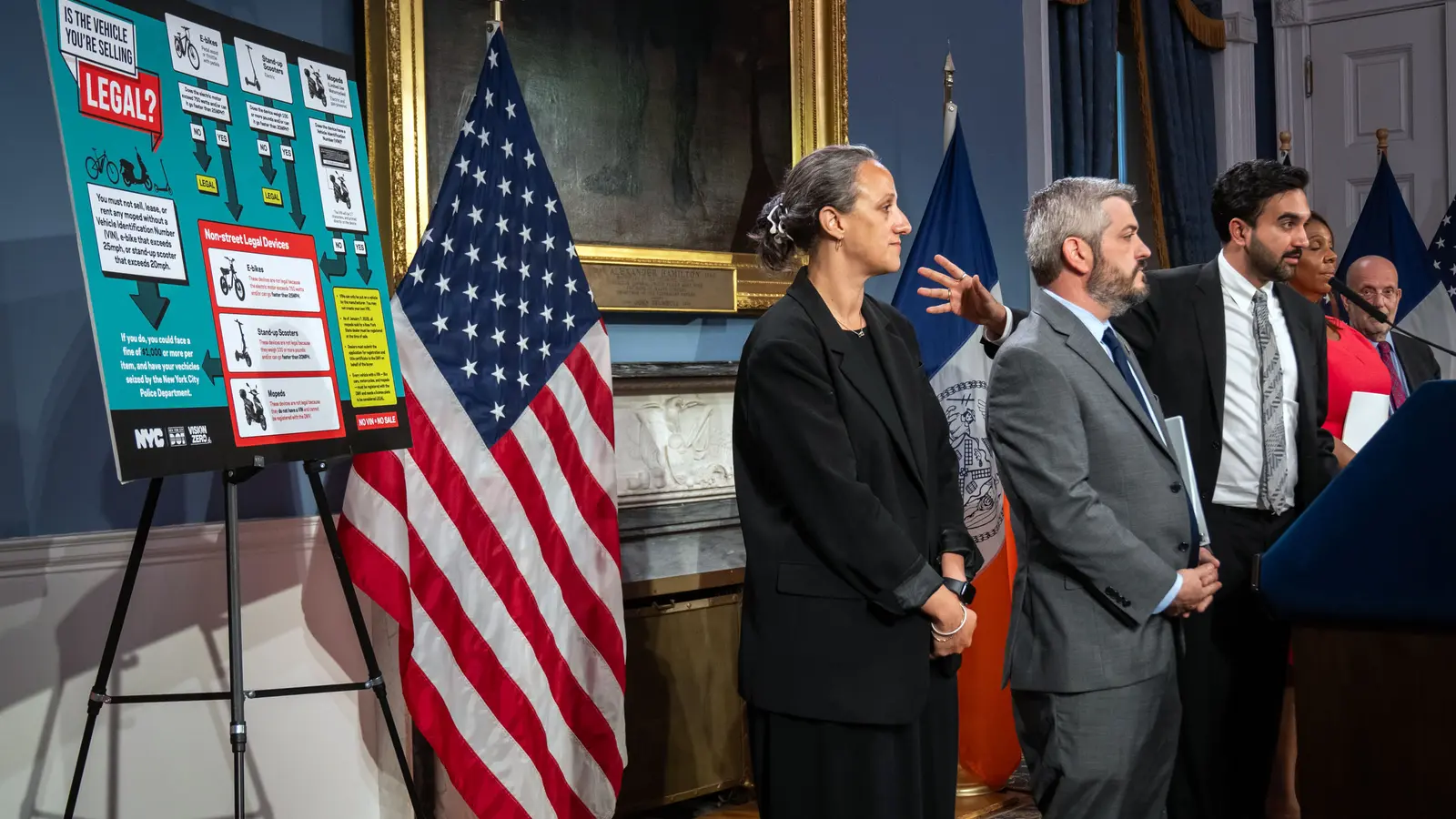
On August 5, 2026, New York City moved from talking about illegal e-bikes to acting on them. Mayor Zohran Kwame Mamdani’s office announced that the city has issued cease-and-desist orders to 42 online retailers, demanding they immediately stop selling motorized devices that exceed the city’s legal limits for speed, weight, or other safety requirements into New York City’s 175 ZIP codes.
This is not a proposal. It is not a hearing announcement or a bill working through committee. It is an enforcement action already sent to specific businesses, with a stated civil penalty attached for retailers who keep selling after receiving one. If you follow RoostMode’s coverage of the City Council’s September 30 safety hearing, announced the day before, treat that story and this one as separate tracks: the Council hearing is about bills that have not passed, while this is the city using authority it says it already has.
What the City Actually Ordered
According to the Mayor’s Office, the 42 orders demand that each retailer immediately stop selling devices into New York City that exceed legal limits for speed, weight, or other safety requirements. The release ties the action directly to a crash the week before the announcement, in which an illegal high-speed device was involved in the death of a 17-year-old New Yorker.
The city says retailers that keep selling prohibited devices after receiving a cease-and-desist order may face a civil penalty of up to $2,000 per illegal sale. Separately, illegal devices found operating on city streets may be impounded regardless of where they were purchased. Those are two different points of pressure: one aimed at the retailer’s storefront, the other at the device once it is on the street.
DOT Commissioner Mike Flynn framed the problem as a combination of speed and weight, calling faster, heavier illegal devices dangerous for everyone sharing the street, riders included. Attorney General Letitia James, whose office issued its own consumer advisory on illegal e-bikes and scooters on July 31, 2026, is also quoted supporting the city’s action. We covered that state-level advisory when it came out, in our New York AG e-bike sales alert, and this week’s orders are the city-level enforcement that advisory pointed toward.
The Thresholds Behind the Orders
The release states plainly what makes a device illegal to sell or operate on New York City streets. Three categories, three thresholds:
- E-bikes: illegal if the motor exceeds 750 watts or the device is capable of speeds over 25 mph.
- Stand-up scooters: illegal if they weigh more than 100 pounds or are capable of exceeding 20 mph.
- Seated mopeds: illegal if they lack a valid, displayed Vehicle Identification Number (VIN).
None of these numbers are new. They describe rules the city says already exist; the cease-and-desist orders are the city applying them to specific online sellers rather than changing what the rules say. That distinction matters for anyone trying to figure out whether this announcement affects a product they already own or one they’re about to buy.
Why the City Is Acting Now
The Mayor’s Office backs the enforcement push with fatality data covering 2017 through 2025. During that period, 45 rider fatalities involved e-bikes capable of exceeding 25 mph, accounting for 54% of all e-bike rider deaths in the city over that span. Fourteen fatalities involved stand-up scooters capable of exceeding 20 mph, representing 52% of scooter rider deaths. Put together, the city says illegal devices account for more than half of all rider fatalities involving e-bikes and stand-up scooters, despite being a subset of everything sold and ridden.
The release also references a specific earlier incident: a crash at the Queensboro Bridge involving an illegal stand-up scooter. Beyond what the city states in its release, we are not characterizing either that incident or last week’s fatal crash further.
Two advocacy voices are quoted supporting the action. Ligia Guallpa, of the Worker’s Justice Project and Los Deliveristas Unidos, frames the issue partly around delivery workers, who she says often face a confusing marketplace where illegal, unsafe vehicles are the most accessible and affordable option. Ben Furnas, of Transportation Alternatives, calls the sale of dangerous devices to customers who believe they’re buying something legal a “shady business practice.”
What This Does, and Doesn’t, Mean for Buyers
It’s worth being precise here, because a cease-and-desist order is a narrower tool than it sounds. These 42 orders tell specific retailers to stop selling specific categories of device into New York City. They do not create a public list of banned products, they do not change the underlying wattage, speed, or VIN thresholds, and they do not automatically make every similar listing illegal everywhere, or legal anywhere, once a retailer complies.
If you live outside New York City, these particular orders don’t apply to you directly. But the underlying logic does: e-bike, scooter, and moped classification rules vary by state and city, and a device that’s illegal to sell or ride in New York City under this 750W/25mph and 100lb/20mph framework can be entirely legal, or entirely illegal, somewhere else under a different standard. Our state-by-state e-bike law roundup covers how much that baseline shifts depending on where you live.
If you live in New York City, or you’re buying for someone who does, the practical takeaway is that the wattage and speed caps the city has always enforced are now backed by an active retailer-facing enforcement action, not just a rule on the books. A retailer removing a listing in response to one of these orders is complying with the city, not issuing a legal ruling on every similar product a competitor still sells.
Practical Checks Before You Buy
Start with the motor. New York City’s e-bike motor cap is 750 watts; a motor larger than that falls outside the legal category regardless of what the seller calls it. Next, check assisted top speed. A device that pedal-assists or throttles past 25 mph as an e-bike, or 20 mph as a stand-up scooter, is outside the legal thresholds the city cited this week, even if the listing calls it a bike or a scooter. For stand-up scooters, weight matters too: anything over 100 pounds falls outside the category regardless of speed.
If you’re shopping for a seated moped rather than a pedal e-bike, ask specifically whether the unit is issued and displays a valid VIN. A moped without one is what the city’s release describes as illegal to sell or operate, independent of its speed or weight. Retailer marketing language, including terms like “street legal” or “DOT compliant,” is not a substitute for checking these numbers yourself. Our e-moto classification guide walks through why pedals alone don’t settle whether something counts as an e-bike, an e-moto, or a moped in the first place.
FAQ
+Does this cease-and-desist action ban specific e-bike or scooter models by name?
+If a retailer stops selling a device in New York City, is that device illegal everywhere?
+I already own an e-bike or scooter that exceeds these thresholds. Does this enforcement action affect me directly?
+What's the difference between this announcement and the City Council hearing announced the day before?
+How can I tell if an e-bike's motor is actually over 750 watts if the listing doesn't say clearly?
Sources
- Mayor Mamdani Issues Cease-and-Desist Orders to Online Retailers Selling Dangerous, Illegal Motorized Devices to New Yorkers (New York City Mayor’s Office, August 5, 2026), our source for the 42 cease-and-desist orders, the 175 ZIP code scope, the 750-watt/25-mph e-bike threshold, the 100-pound/20-mph stand-up scooter threshold, the seated moped VIN requirement, the up-to-$2,000 civil penalty and impoundment provisions, the 2017 to 2025 fatality figures, the Queensboro Bridge and prior-week fatal crash references, and the quotes attributed to Mayor Mamdani, Commissioner Flynn, Attorney General James, Ligia Guallpa, and Ben Furnas.
- Attorney General James Reminds New York Consumers and Businesses About E-Bike and E-Scooter Laws (New York State Office of the Attorney General, July 31, 2026), the state-level consumer advisory that preceded this city-level enforcement action, covered separately in our New York AG e-bike sales alert.
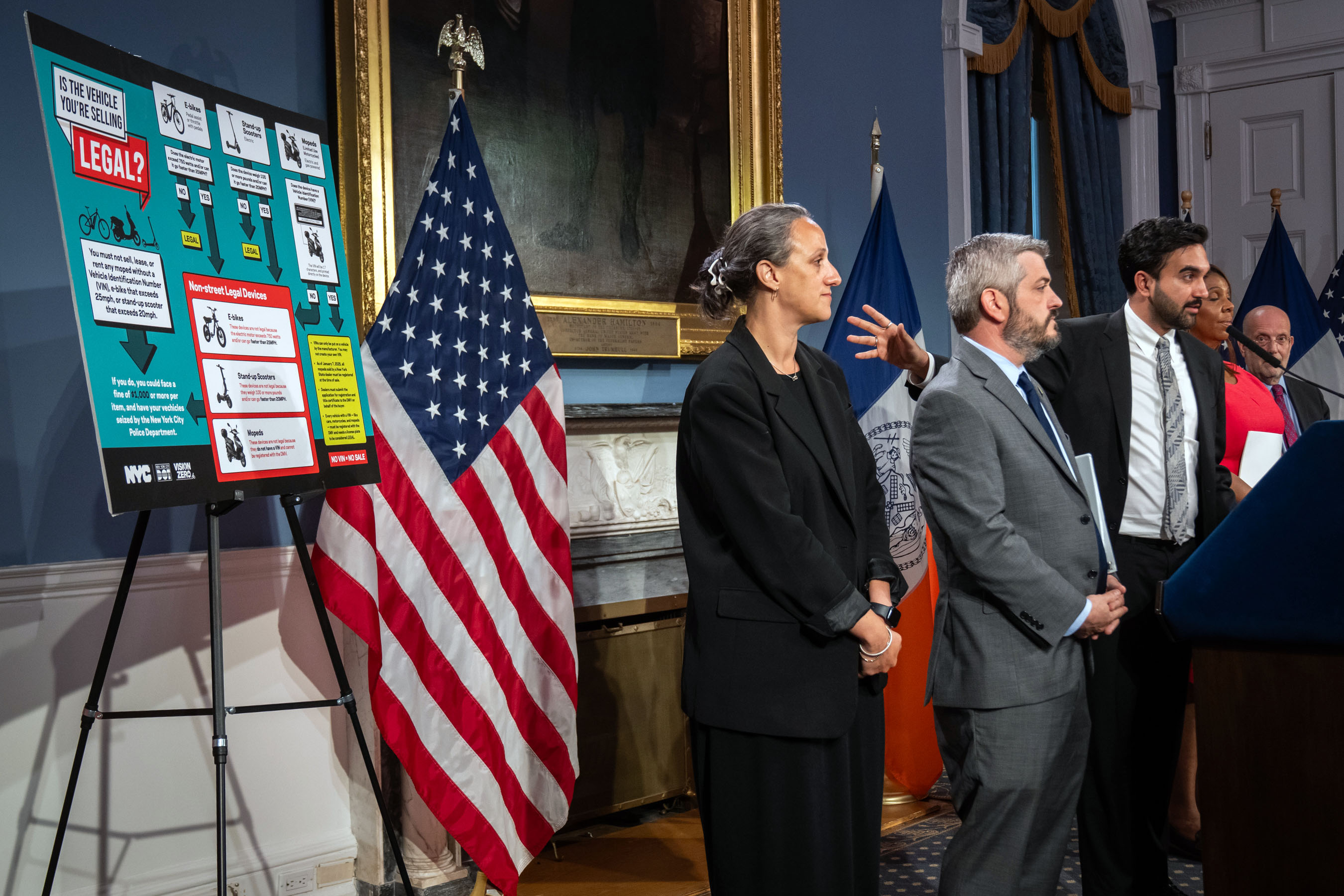
- Hero image: official press-release image, New York City Mayor’s Office, cropped and optimized by RoostMode.
RoostMode has not tested, inspected, or measured any product referenced in this article, and this article is not legal advice. Classification law changes by jurisdiction and over time; confirm current rules with the relevant city, state, or the retailer directly before buying or riding.
Read next
NYC Council Sets September 30 E-Bike and E-Scooter Safety Hearing
The proposed-bills side of this week's New York City e-bike news, separate from this enforcement action.
New York's AG Warns That Overpowered Machines Sold as E-Bikes Are Illegal
The state-level consumer advisory that came before this week's city-level enforcement orders.
The E-Moto Problem: When an Electric Bike Is Not an E-Bike
Why pedals alone don't settle whether a machine is an e-bike, an e-moto, or a moped.